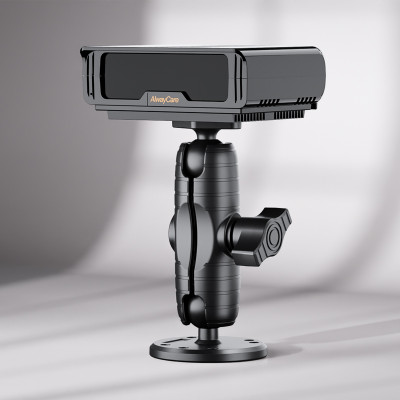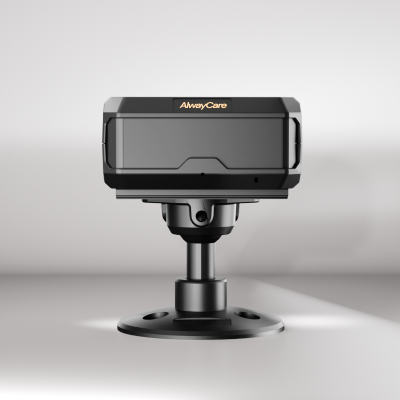


A commercial vehicle camera system combines cameras, a mobile recorder (MDVR), an in-cab monitor, and often AI or radar sensors to give drivers visibility and fleets recorded evidence. Trucks, buses and work vehicles use these systems to cover blind spots that mirrors cannot see and to support insurance claims after an incident.
This guide is the starting point for the whole topic. Each section answers one planning question in a few sentences, then links a full comparison guide — so you can read the short answer here and the complete analysis when you need it.
What Does a Commercial Vehicle Camera System Include?
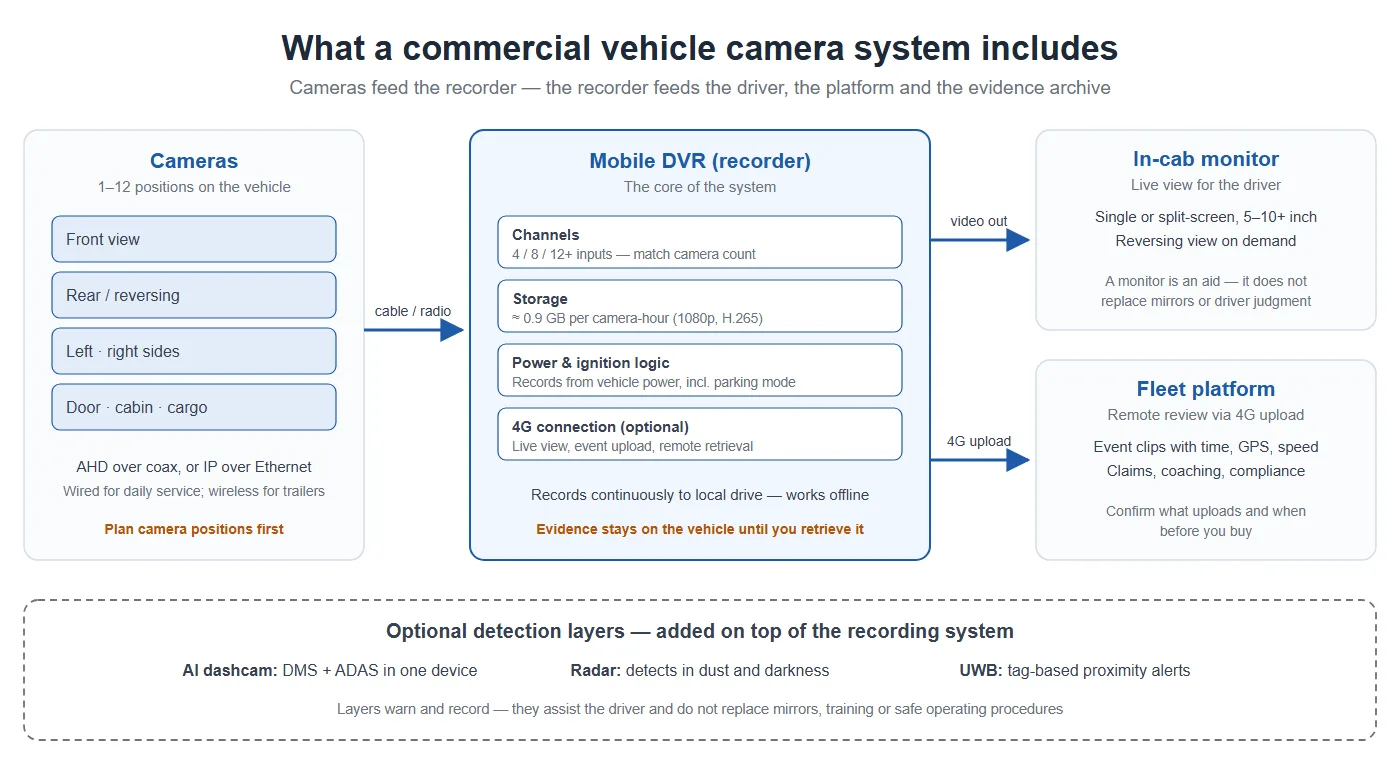
Most systems on trucks and buses share four building blocks. Cameras cover the views you need — front, rear, both sides, plus door, cabin or cargo positions on larger vehicles. A mobile DVR (MDVR) records those cameras to a local drive and is the core of the system. An in-cab monitor shows the driver a live or reversing view. A fleet platform, connected by 4G, uploads event clips for remote review.
On top of these, many fleets add detection layers: an AI dashcam layer for driver monitoring and road warnings, or radar and UWB sensors for work-site proximity alerts.
Browse the hardware: Mobile DVR and Vehicle Camera ranges.
Which Recording System Fits Your Fleet?
A dash cam records one or two views from inside a vehicle. An MDVR records four to eight or more cameras across a truck or bus, stores far more footage, and feeds a fleet platform. If your fleet runs cars and vans, a dual-lens AI dashcam is often enough. If it runs trucks, buses, or any vehicle with large blind spots, an MDVR is the right tool.
The full decision — cameras, storage, installation, insurance evidence and a fleet-size matrix — is in the MDVR vs Dash Cam guide.
How Many Channels Do You Need?
Each channel on an MDVR is one camera input. Count the camera positions you actually need first; the channel count follows. A 4-channel recorder covers the basic four views — front, rear and both sides — on vans and rigid trucks. An 8-channel adds cabin, door and cargo views for buses and heavy trucks. 12 channels and above fit articulated vehicles, mining trucks and multi-door passenger fleets.
See the channel-planning matrix by vehicle type in 4-Channel vs 8-Channel vs 12-Channel MDVR.
How Much Storage Will You Need?
One rate estimates it: at 1080p with H.265 — about 2 Mbps per camera — each camera records roughly 0.9 GB per hour. A 4-camera system on a 10-hour day needs about 36 GB per day. H.264 roughly doubles that. These figures assume continuous recording at those settings; your actual bitrate and parking mode change the result, so treat them as a planning starting point.
Open the formula and worked examples in the Fleet MDVR storage calculator.
Should Your Cameras Be Wired or Wireless?
A wired camera sends video over a cable — the most stable picture for daily commercial use. A wireless camera sends video by radio and still needs power, so it installs faster but trades away some signal stability. Choose wired for trucks and buses in daily service. Choose wireless for trailers, quick retrofits and temporary setups.
The full comparison — signal stability, delay risk and kit types — is in Wired vs wireless backup cameras.
AHD or IP Cameras?
AHD cameras send uncompressed video over coaxial cable straight to the recorder — simple, low delay and cost-effective for multi-camera MDVR installations. IP cameras send compressed network video over Ethernet — higher resolution and more flexible, but they need switches, bandwidth planning and compatible inputs. Most commercial fleets pick AHD for recording systems and IP where AI analysis or very high resolution is required.
Check cabling, latency and recorder compatibility in AHD vs IP vehicle cameras.
Do You Need Driver Monitoring or Collision Warning?
DMS watches the driver — fatigue, distraction, phone use. ADAS watches the road ahead — lane position, closing speed, collision risk. An AI dashcam is the device that can carry both functions, plus recording. They are layers of one system, not alternatives: most fleets end up running all three in a single dual-facing device.
Compare the three layers and see how they cooperate in DMS vs ADAS vs AI dashcam.
What About Radar and UWB Proximity Warning?
Cameras recognize people without any tags but need line of sight. Radar works through dust, darkness and rain but cannot tell a person from an object. UWB tag systems track with high accuracy around corners — if every pedestrian wears a tag. For highway fleets, camera and radar layers cover most needs. For mining trucks, forklifts and high-risk work sites, layering two technologies is the standard pattern.
See when to layer them in Camera vs Radar vs UWB proximity warning.
How Many Cameras Does Each Vehicle Type Need?
Planning starting points, not fixed rules: a van or small delivery truck typically runs 2–4 cameras — front, rear, sometimes sides. A rigid truck fits 4–8, adding side and cabin views. Buses typically plan 6–8 positions — front, rear, both sides, doors and cabin — with the exact set depending on door count and operator requirements.
Map each body section to channels and claim history in Bus camera systems, and see the recorder side in AI MDVR.
Quick Comparison: Camera System Types at a Glance
Storage figures below assume 1080p H.265 at about 2 Mbps per camera — roughly 0.9 GB per camera-hour — over a 10-hour day. H.264 roughly doubles them.
| System type | Fits best | Cameras | Typical storage/day | Main job | Deep guide |
|---|---|---|---|---|---|
| AI dashcam | Cars, vans, light fleets | 1–2 | ~9–18 GB | Driver + road evidence | MDVR vs Dash Cam |
| 4-channel MDVR | Vans, rigid trucks | 4 | ~36 GB | Four-view coverage | Channel guide |
| 8–12-channel MDVR | Buses, heavy trucks, mining | 6–12 | ~54–108 GB | Full coverage incl. cabin, doors | Channel guide |
| + AI detection layer | Fleets with fatigue or distraction risk | — | adds little | Driver & road warnings | DMS vs ADAS |
| + Radar / UWB layer | Work sites, mining, forklifts | — | adds little | Proximity alerts in dust and darkness | Camera vs Radar vs UWB |
A camera system is an aid: it supports the driver and the fleet — it does not replace mirrors, training or safe operating procedures.
Frequently Asked Questions
What is the difference between a dash cam and a commercial vehicle camera system?
A dash cam is one or two lenses recording from inside the cabin. A commercial vehicle camera system is a multi-camera installation: several cameras feed an MDVR that records to a local drive and supports a fleet platform. Fleets with trucks and buses need the system, not the single lens.
How many cameras can an MDVR support?
It matches the channel count: 4, 8 or 12+ inputs depending on the model. Some AI MDVRs split channels between regular recording cameras and AI cameras — check the specification sheet for the exact split.
Do vehicle cameras work at night and in bad weather?
Quality vehicle cameras use starlight or infrared sensors for low light and carry IP69K-rated waterproofing for weather. Radar adds detection where cameras lose contrast — dust, heavy rain and darkness. Performance varies by model, so verify the rating on the specification sheet.
How much storage does a fleet camera system need per month?
Start from the daily rate: a 4-camera system at 1080p H.265 needs about 36 GB per day, so roughly 1.1 TB per 30-day month at continuous recording. Multiply by your camera count and hours, then confirm media options in your quotation.
Can one system cover both safety recording and driver monitoring?
Yes. A dual-facing AI dashcam carries DMS and road-facing ADAS with recording in one device, and AI MDVRs add AI channels to a multi-camera system. Confirm which events are supported and how alerts are delivered — capability varies by model.
Plan Your System With Real Vehicle Data
Send us your vehicle types and the views you need covered — we will map camera positions and recorder channels for your fleet, and confirm storage options in a quotation.