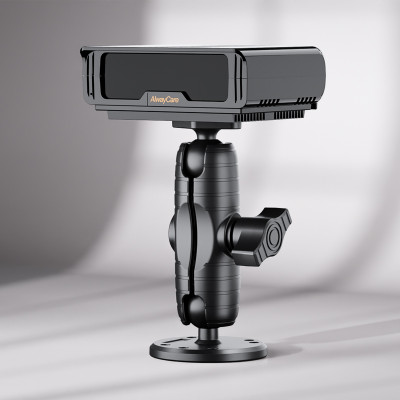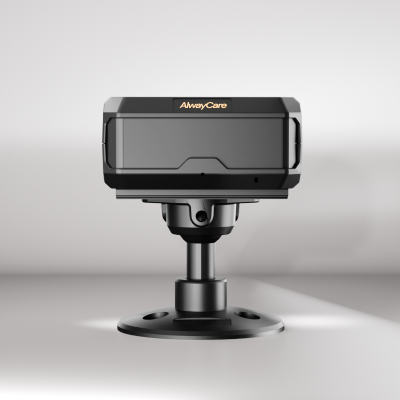


Most buses plan six to eight camera positions: front, rear, both sides, door, cabin, and sometimes cargo or boarding views. On an 8-channel MDVR that fits with room to spare. Transit buses add door and boarding evidence needs, school buses add cabin coverage expectations, and coaches add passenger-area views. Plan positions by body layout first, then match the recorder.
Plan by body section, not by camera count
The useful question is never "how many cameras" but "which sections of the bus need to be visible, and why." Each position answers a specific operational question:
| Position | What it answers |
|---|---|
| Front | Road events, forward collisions, plate evidence |
| Door / boarding | Boarding disputes, fare incidents, door-area safety |
| Cabin / saloon | Passenger incidents, vandalism, driver support |
| Left / right sides | Lane changes, passing traffic, mirror-blind areas |
| Rear | Reversing, tailgating from behind, rear-end claims |
| Cargo / luggage | Load handling on coaches and airport shuttles |
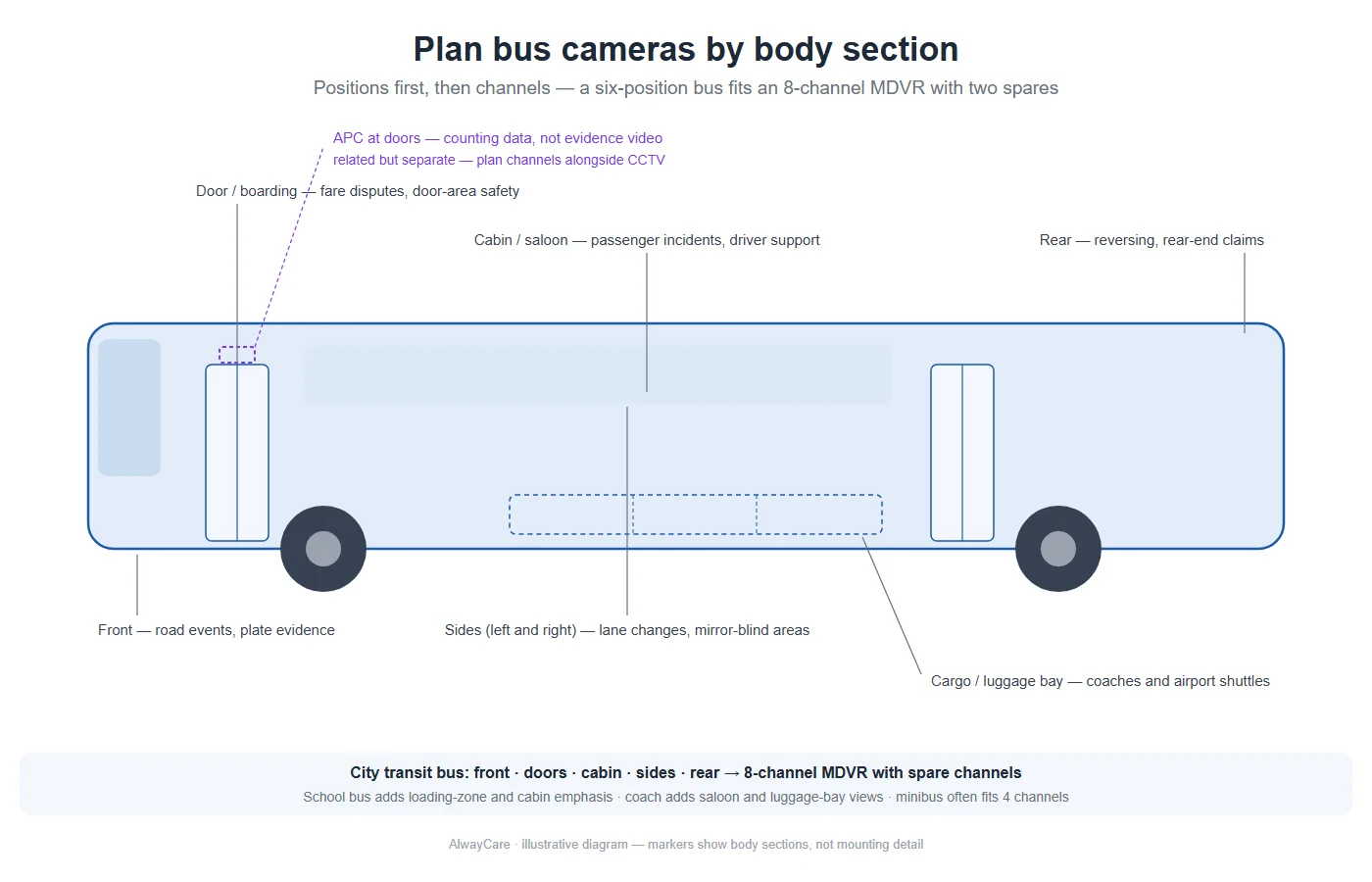
Illustrative positions by body segment — planning examples, not mounting detail.
Start from the questions your operation actually gets asked — claims, complaints, disputes — and let the positions follow.
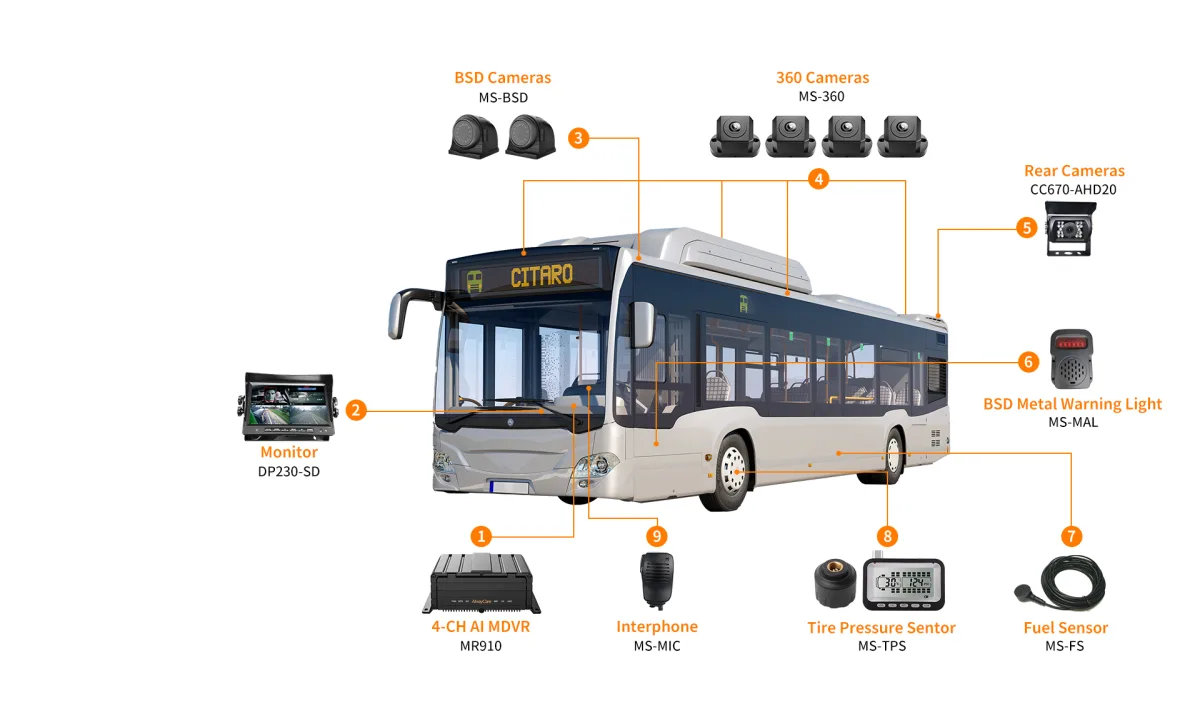
System layout example: blind-spot, 360-degree and rear cameras around a city bus.
What differs between bus types
| Vehicle type | Typical position set | Extra considerations |
|---|---|---|
| City transit bus | Front, door(s), cabin, sides, rear | Multiple doors; boarding evidence; passenger counting cameras alongside |
| School bus | Front, rear, sides, cabin, door | Cabin and door coverage usually expected; loading-zone view; student privacy policy required |
| Coach / intercity | Front, rear, sides, saloon, cargo | Long-distance recording hours; luggage bay; driver rest compliance context |
| Minibus / shuttle | Front, rear, cabin, door | 4-channel systems often sufficient |
The pattern: the more passengers and doors, the more the system shifts from "road evidence" toward "cabin and door evidence."
For school buses specifically, the stakes are regulatory as well as operational. NHTSA calls the school bus the most regulated vehicle on the road, with safety standards "above and beyond those for regular buses" — which is why cabin and loading-zone coverage is usually expected rather than optional.
From positions to channels
Each camera position takes one recorder channel. A six-position transit bus fits a 8-channel MDVR with two spare channels; a school bus with loading-zone and driver views may use all eight. Two practical rules:
- Leave one spare channel where budget allows — door cameras and cabin cameras are the most common later additions.
- Confirm input types when mixing standard cameras with AI or counting cameras; some recorders split channels between recording and AI functions.
For the full channel-planning method, see our channel selection guide; the storage sizing method is covered in our fleet storage guide — a 6-camera bus records roughly six times the per-camera rate, so retention policy and drive size must be planned together.
Passenger counting cameras: related but separate
Automatic passenger counting (APC) uses overhead cameras at doors to count boardings and alightings. They record data, not usable video evidence, and they take their own channels or connect separately. If your funding or reporting depends on ridership numbers, plan APC positions at the same time as CCTV positions — both live at the doors.
Privacy and retention, briefly
In-cabin cameras record identifiable people, so two things belong in writing before rollout: who can access footage, and how long it is kept. Retention should match your claims and complaint windows — long enough to answer a late-reported incident, short enough to be defensible. Jurisdiction-specific privacy rules vary; confirm yours with legal counsel. A full retention and privacy policy guide follows separately.
Honest limit: cameras record and support alerts; they do not prevent incidents on their own. Driver training, door procedures, and safe operations remain the primary controls.
Frequently asked questions
How many cameras does a city bus need? As planning starting points: six to eight positions — front, rear, sides, doors, and cabin — with the exact set depending on door count and operator requirements. Map positions to your claim history before fixing the number.
What cameras does a school bus need beyond a transit bus? Loading-zone and cabin views are the usual additions, and a written student-privacy policy is effectively mandatory. Door and cabin footage is what most school-bus incident reviews turn on.
Do passenger counting cameras count as CCTV? No. APC cameras collect counting data at the doors; they do not provide evidence-grade video. Plan them alongside CCTV but as separate positions and channels.
How long should a bus keep its footage? Long enough to cover your late-reported claims and complaints — often weeks, set by policy. Balance retention against storage: every added camera shortens the days a given drive can hold.
Can the system record while the bus is parked? Yes, with parking-recording configurations — event-triggered or scheduled. Parking mode increases storage needs, so include it in sizing rather than discovering it later.
Plan your bus camera layout with us
Send us your bus type, door layout, and the incidents you need evidence for — we will return a position-by-position camera plan with channel count and storage sizing.
- Start from our Public Bus Fleet solution, Mobile DVR systems and APC counters.
- Counting passengers? Read Automatic Passenger Counting Systems for Buses.
- Sizing the recorder next? See 4-Channel vs 8-Channel vs 12-Channel MDVR.