
- Tag Filter
- Problem Solving
- Collision Avoidance
- Blind Spot Monitoring
- Anti-fatigue
- Scenarios
- Vehicle Manufacturers
- Mining Fleets
- Logistics and Transportation
- Hazardous Chemicals Fleets
- School Bus Fleets
- Public Bus Fleets
- Forklift Fleets
- Insurance
- Government and Public Safety
- Business Attributes
- Customized
- Hot Sale
- New Product
- Fast Delivery
Wireless Camera
Wireless Camera and Monitor Kits for Commercial Vehicles
Digital wireless camera and monitor kits that remove cabling between the cab and the trailer or rear of the vehicle, plus magnetic and solar wireless cameras.
- 14 wireless models
- 2.4GHz digital transmission
- OEM / ODM customization
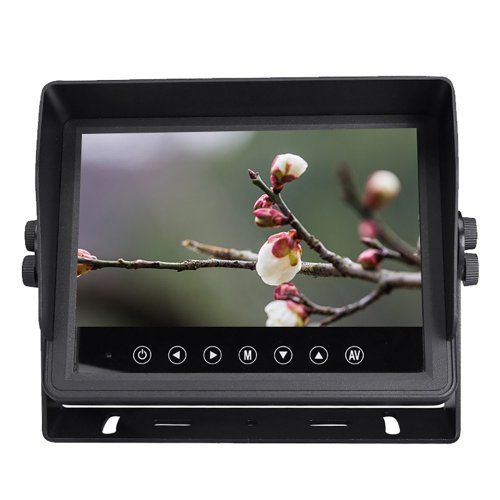
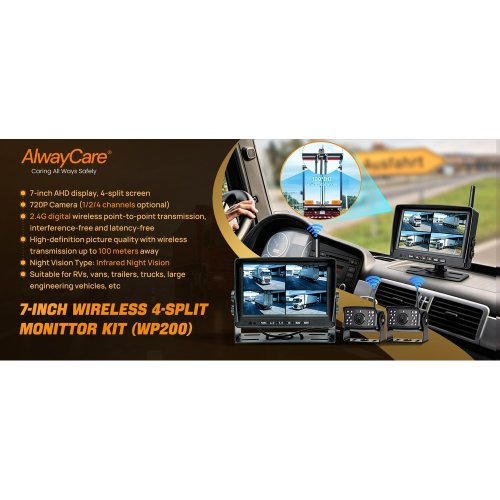
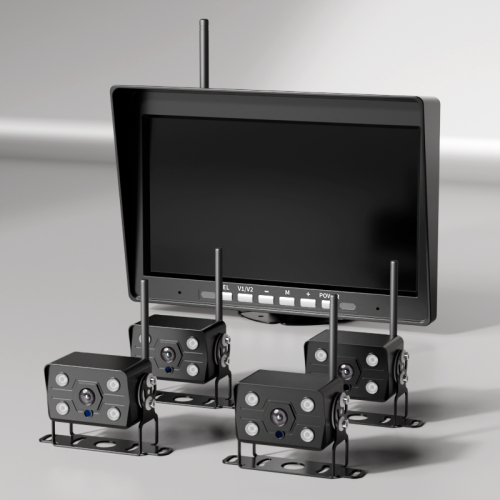
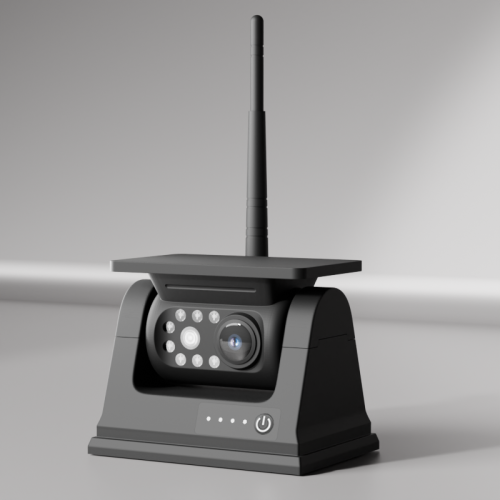
Wireless Camera Models at a Glance
Values come from each product's factory datasheet. Where a value is not listed here, open the product page.
| Model | Type | Display | Cameras | Transmission | Recording | Power |
|---|---|---|---|---|---|---|
| WP210 | Monitor kit | 7-inch, 1024×600 | 1× 720P | 2.4GHz, 100M+ | SD loop, up to 128GB | DC 9–35V |
| WP210-A | Monitor kit | 7-inch, 1024×600 | 2× 720P | 2.4GHz, 100M+ | SD loop, up to 128GB | DC 9–35V |
| WP210-B | Monitor kit | 7-inch, 1024×600 | 4× 720P | 2.4GHz, 100M+ | SD loop, up to 128GB | DC 9–35V |
| WP220 | Monitor kit | 7-inch, 1024×600 | 1× 720P | 2.4GHz, 100M+ | SD loop, up to 128GB | DC 9–35V |
| WP230 | Monitor kit | 7-inch, 1024×600 | 1× 720P | 2.4GHz, 100M+ | SD loop, up to 128GB | DC 9–35V |
| WP235 | Monitor kit | 7-inch, 1024×600 | 2× 720P | 2.4GHz, 400M | SD loop, up to 128GB | DC 9–35V |
| WP235-A | Monitor kit | 7-inch, 1024×600 | 2× 720P | 2.4GHz, 400M | SD loop, up to 128GB | DC 9–35V |
| WP240-A | Monitor kit | 7-inch, 1024×600 | 2× 720P | 2.4GHz, 100M+ | SD loop, up to 128GB | DC 9–35V |
| WP240-B | Monitor kit | 7-inch, 1024×600 | 4× 720P | 2.4GHz, 100M+ | SD loop, up to 128GB | DC 9–35V |
| WP250-B | Monitor kit | 10.1-inch, 1024×600 | 4× 720P | 2.4GHz, 100M+ | SD loop, up to 128GB | DC 9–35V |
| DP240-1 | Monitor and camera kit | Monitor, quad-view modes | 1080p night-vision camera | Over 200m | 128GB SD card | 9–30V |
| CC981 | Solar camera | — | 720P / 1080P | 2.4GHz, 400M | — | Solar panel + 9600mAh battery |
| CC981-W | Solar camera | — | 1080p | 328ft unobstructed | — | Solar + 9600mAh battery |
| CC982-W | Magnetic camera | — | 1–4 channel AHD, 1080P / 720P | 2.4GHz | — | 10–36V DC |
Open each product page for the full specification. The kit contents and cable options are confirmed in your quotation.
Which Wireless Kit Fits Your Vehicles?
Three common starting points. Your quotation confirms the final configuration.
You need one reversing camera and a monitor
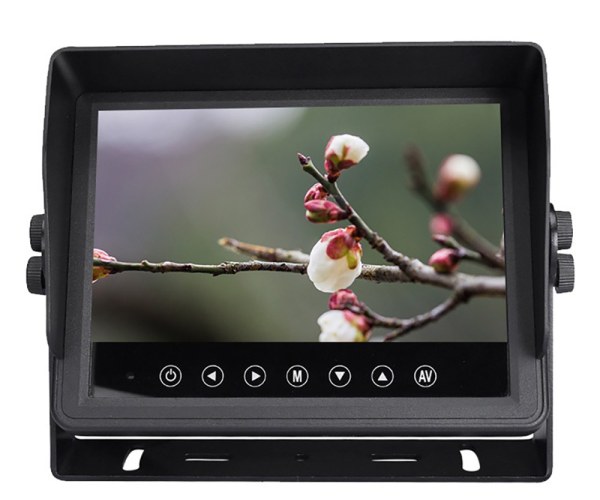
Choose the WP210, WP220 or WP230. Each is a 7-inch monitor kit with one 720P camera and 2.4GHz digital transmission.
See the models 02You need two or four cameras
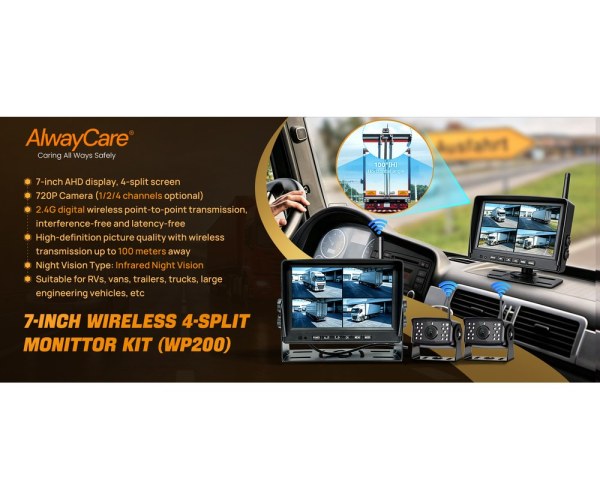
Choose the WP210-A, WP235, WP235-A or WP240-A for two cameras, or the WP210-B, WP240-B or the 10.1-inch WP250-B for four.
See the models 03You need a magnetic or solar camera
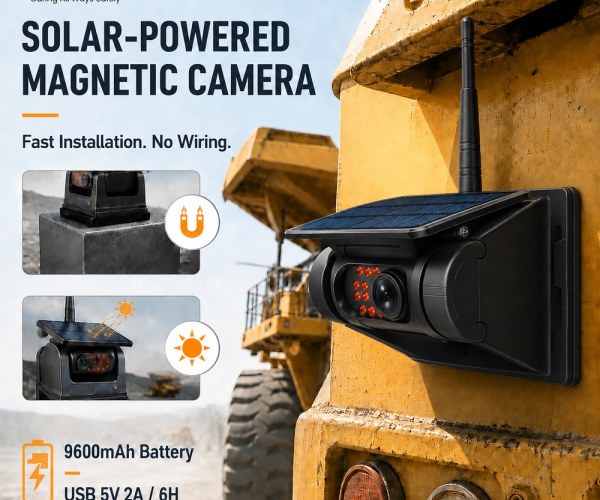
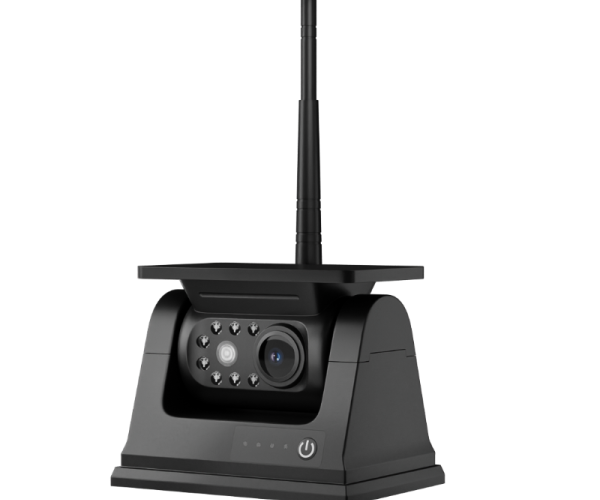
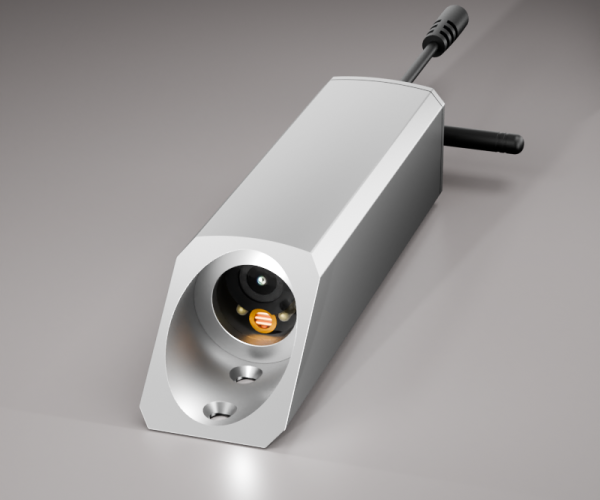
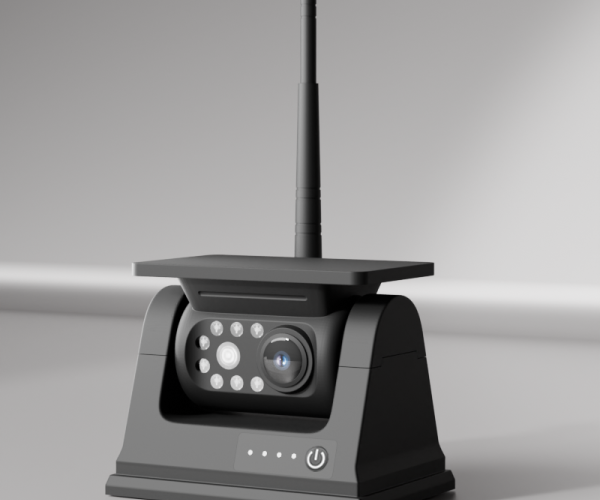
Choose the CC981 or CC981-W solar cameras with a 9600mAh battery, or the CC982-W magnetic camera with laser alignment.
See the modelsWireless Camera Models


Related Solutions and Industries
See how Wireless Camera is used in a full program and in your type of operation.
Typical Equipment Packages
Starting points for planning. The final bill of materials is confirmed per vehicle in your quotation.
Reversing kit
For trucks and trailers that need a rear view without running cables.
- WP210, WP220 or WP230 7-inch monitor with one 720P camera.
- Mounting hardware Confirmed per vehicle.
- SD card Loop recording up to 128GB.
Multi-camera kit
For vehicles that need several views on one screen.
- WP240-B or WP250-B Four 720P cameras with a quad-split monitor.
- Wireless cameras Included with the kit.
- SD card Loop recording up to 128GB.
Choose How You Want to Work With Us
Hardware Purchase
Buy factory-direct hardware for your own fleet. Platform and protocol compatibility is confirmed per model in your quotation.
Inquire HardwareOEM & ODM
Logo, packaging, firmware behavior and interface customization for your market and fleet platform.
OEM / ODM ServicesPlatform Integration
For telematics providers and integrators: protocol support such as JT/T 808 and JT/T 1078 depends on the model. Send us your platform requirements.
Partner With UsFrom Inquiry to Delivery in Four Steps
Share Your Requirements
Send fleet size, vehicle models and target functions through the inquiry form.
Version & Quotation
Our engineers map your needs to the right configuration and provide a quotation.
Sample Evaluation
Sample units are available for road testing before you commit to a bulk order.
Production & Delivery
Bulk orders ship with factory QC reports, export documents and the 15-month warranty from dispatch.
What You Receive From AlwayCare
Deliverables you can plan around. Camera views are for the driver; they do not control the vehicle.
Configuration list
A recommended equipment list for your vehicle types, confirmed in your quotation.
Installation topology
Example layouts and wiring guidance for the selected components.
Sample units
Sample units for road testing before you commit to a bulk order.
Factory QC report
Bulk orders ship with factory QC reports and export documents.
15-month warranty
Warranty from factory dispatch. Final terms are confirmed in your quotation.
Certification documents
Documents for your model and target market are available on request.
Certifications held by AlwayCare. Documents are available on request for your model and market.
 ISO 9001
 CE
CE UKCA
UKCA RED
RED RoHS
RoHS WEEE
WEEE SGS
SGS- IATF 16949Factory
- FCCCertified
Frequently Asked Questions
How do the wireless kits connect?
The WP series uses 2.4GHz digital frequency-hopping transmission between the cameras and the monitor. The listed range is 100M+ for most models and 400M for the WP235 and WP235-A.
How many cameras does each kit include?
The WP210, WP220 and WP230 include one camera. The WP210-A, WP235, WP235-A and WP240-A include two. The WP210-B, WP240-B and WP250-B include four.
Can the monitors record?
The WP series lists SD loop recording up to 128GB. The DP240-1 lists a 128GB SD card.
How do the solar cameras work?
The CC981 and CC981-W use a solar panel with a 9600mAh battery and a magnetic base for installation without wiring. Confirm the range and mounting for your vehicle with our engineers.
Do you provide samples for testing?
Yes. Sample units are available for road testing before a bulk order. Contact us with your vehicle types.
What warranty applies?
AlwayCare products carry a 15-month warranty from factory dispatch. Confirm the final terms in your quotation.
Contact Us
Send your vehicle types, fleet size and target functions. Our engineers will recommend a wireless camera configuration and provide a quotation.