

Automatic Passenger Counting Accuracy: A Fleet Test Guide
Automatic passenger counting accuracy should be verified by comparing the system's boarding and alighting records with an independent reference under representative operating conditions. A percentage quoted without its measurement method cannot tell a fleet buyer whether the data will support stop analysis, passenger-load estimates or reporting.
This guide explains how to design a practical APC validation exercise, calculate useful error measures and agree on acceptance criteria. It follows the system overview in AlwayCare's automatic passenger counting guide.

Define what the count must support
Start with the decision the data will inform. Route planning, crowding analysis and passenger-load estimation can place different demands on the same dataset.
Specify whether acceptance applies at the door, stop, trip or route level. State whether boardings and alightings will be assessed separately. Also define how counts are matched to vehicle, date, trip and stop.
The National Center for Applied Transit Technology's Data Practices Guidebook distinguishes passenger counts at vehicle doors from fare transactions and vehicle-location data. Build the validation plan around the records your project actually requires.
Select representative doors, routes and passenger flows
Choose test vehicles that represent the proposed rollout. Include different door layouts and mounting arrangements where they may affect the counting view.
Sample the flows that the fleet expects to measure:
- Quiet and busy boarding periods.
- Boarding and alighting at the same time, where this occurs.
- Passengers waiting or turning around in the doorway.
- Relevant bags, mobility aids and accompanied children.
- Lighting transitions and the door's normal open-and-close cycle.
- Routes or operating periods that challenge data synchronization.
Record the installation, software version and calibration before testing. Keep installation changes separate from the original configuration so that improvements can be traced.
Do not choose the sample size from a convenient round number alone. Agree on a sampling plan with the customer and, where needed, a specialist who can assess the precision required for the intended use.
Create an independent reference count
Use trained observers or a permitted recording-review process to establish the reference. Define what counts as a boarding or alighting event before collection begins.
The reference record should use the same identifiers and time boundaries as the APC export. Otherwise, a correctly counted event can appear to be an error because the two records describe different stops or periods.
Resolve ambiguous events through a documented review. Flag reference uncertainty rather than silently adjusting the manual count to match the device. Where recordings are used, establish permission, access and retention arrangements appropriate to the deployment.
Separate signed error from absolute error
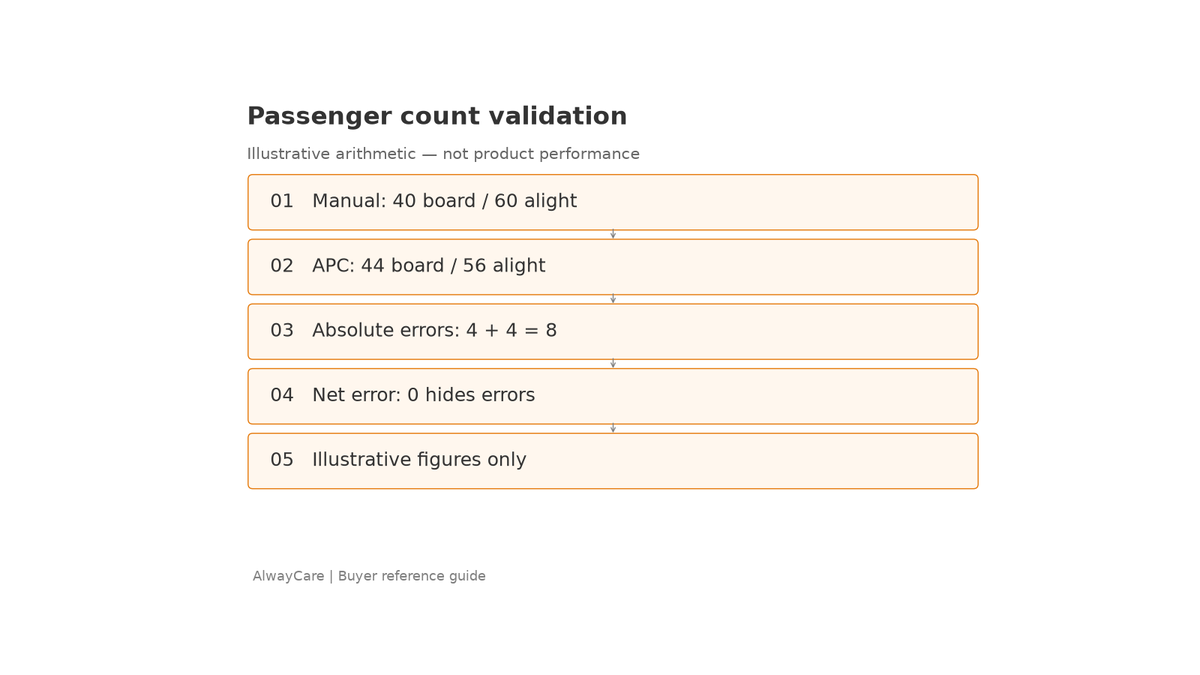
Overcounts and undercounts can cancel in a total. Use more than one measure to make that visible.
The following is an illustrative calculation, not a universal APC certification method:
| Sample unit | Reference count | APC count | Signed difference | Absolute difference |
|---|---|---|---|---|
| Stop A boardings | 40 | 44 | +4 | 4 |
| Stop B boardings | 60 | 56 | -4 | 4 |
| Total | 100 | 100 | 0 | 8 |
The aggregate boarding total matches the reference. However, the sum of absolute differences is eight passengers.
For this defined sample, a weighted absolute count error can be calculated as:
100 × sum of absolute count differences ÷ total reference passengers = 8%.
This is an error measure across the selected units. It does not establish that 92% of individual passengers were correctly identified.
Apply the same approach to alightings, keeping the direction separate. Where a unit has no reference passengers, report any false counts explicitly; do not divide by zero or discard the case without explanation.
Check passenger-load drift
An estimated onboard load starts with a known or reconciled starting load, adds boardings and subtracts alightings. Errors can accumulate across the trip even when a daily total looks reasonable.
Review load estimates at meaningful points, such as a terminal where the vehicle is known to be empty. Investigate negative loads or unexplained residual passengers rather than automatically resetting them without a record.
If passenger-load analysis is a project requirement, include its validation in the acceptance plan. A good boarding total alone does not establish a reliable running load.
Measure data completeness alongside counting error
A counter may produce accurate records for the trips that reach the platform while other trips are missing.
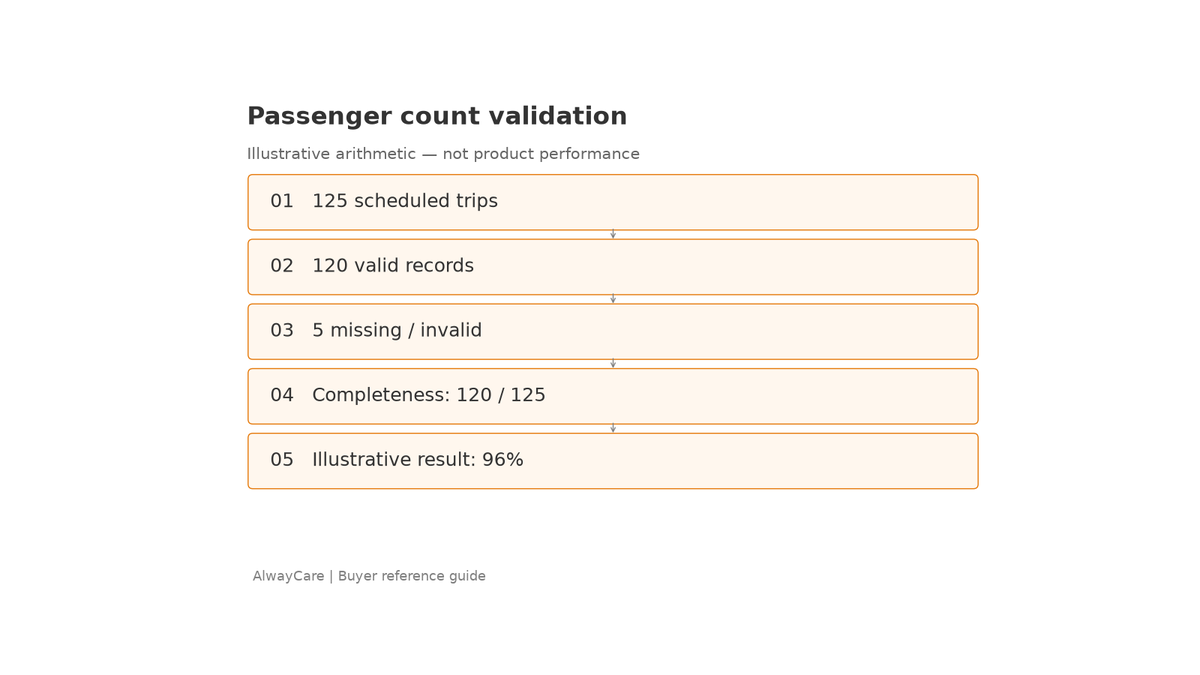
Define a valid record and an expected reporting unit. Then measure completeness independently. For example, if 120 of 125 expected trip records are valid and delivered, trip-record completeness is 96%.
Report why the other five records are unavailable. Possible causes to investigate include offline equipment, missing identifiers, duplicate exports or transmission failures. None should be relabeled as accurate counts.
| Acceptance area | Evidence to request |
|---|---|
| Count error | Direction-specific comparison with reference counts |
| Door coverage | Records from every passenger door in scope |
| Trip completeness | Expected records compared with valid delivered records |
| Stop matching | Count events aligned to the intended stop and time |
| Load estimate | Reconciliation at selected points |
| Change control | Configuration history and retest results |
Agree on acceptance and revalidation
Write the pass criteria, sample rules and treatment of exceptions before the final test. Include the process for correcting installation issues and repeating affected tests.
Retest after changes that could alter the counting view or logic, such as moving a sensor, modifying a doorway or updating the counting software. Set a monitoring process for missing trips and unusual count patterns between formal validations.
For international projects, keep the technical validation consistent while checking local reporting requirements separately. A test accepted by one customer does not automatically establish eligibility for a reporting scheme in another country.
Prepare the information needed for system selection
AlwayCare's AI passenger counting range can be reviewed against the planned door coverage and data workflow. Confirm the counting channels, export fields, positioning inputs and platform support for the selected model.
Before requesting a proposal, prepare door dimensions, mounting photographs, bus types, route-data requirements and the draft acceptance plan. Share these project details with AlwayCare so the hardware discussion starts with a measurable requirement.
Frequently asked questions
Is a quoted 98% or 99% accuracy enough?
No. Ask what was measured, how the reference was created, which operating conditions were included and how missing data was treated.
Can accurate totals hide counting errors?
Yes. Overcounts and undercounts can cancel. Assess absolute differences and direction-specific results as well as aggregate totals.
Should an APC pilot compare counts with ticket sales?
Fare transactions can be a useful separate dataset. They are not automatically an independent passenger count because payment and passenger movement can differ.