

Forklift Pedestrian Detection: A Fleet Pilot Test Checklist
A forklift pedestrian detection system should be tested against the movements, blind areas and working conditions found at the intended site. A successful demonstration in an empty yard does not establish that the same configuration will work around loaded trucks, metal racks and busy access points.
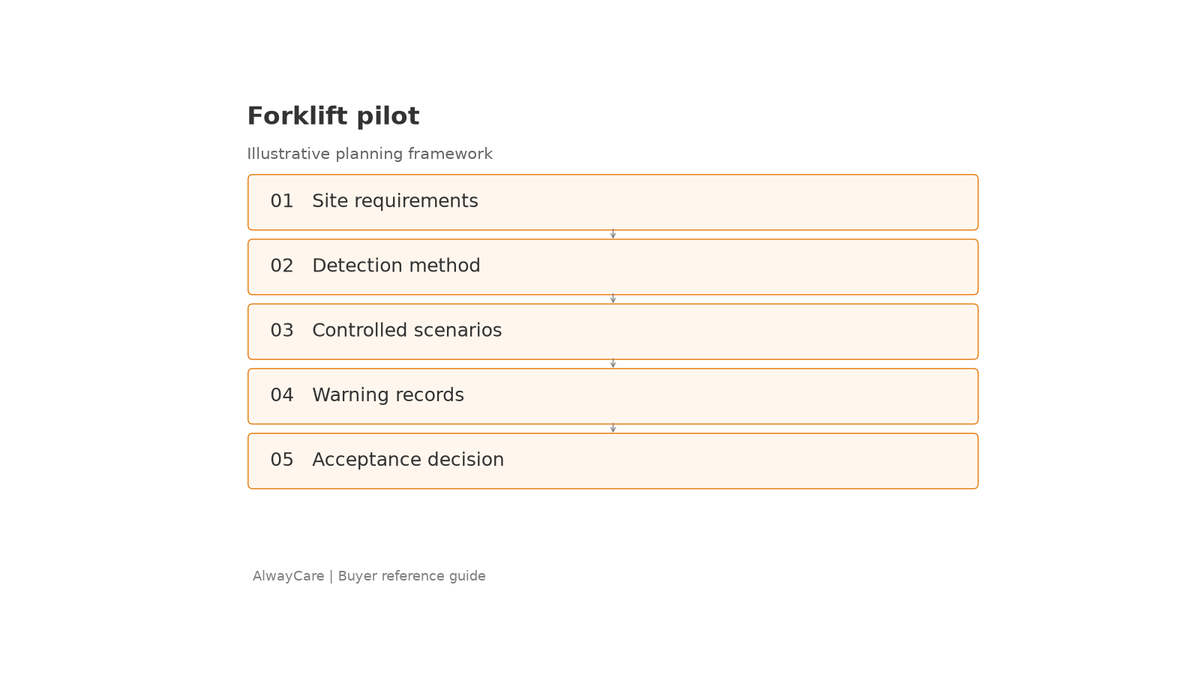
Before ordering for the full fleet, agree on a controlled pilot. Record what the system detects, where warnings begin, which situations it misses and whether operators can act on the warning. This guide provides a practical test framework for fleet buyers, distributors and system integrators.
Define the warning task before choosing the technology
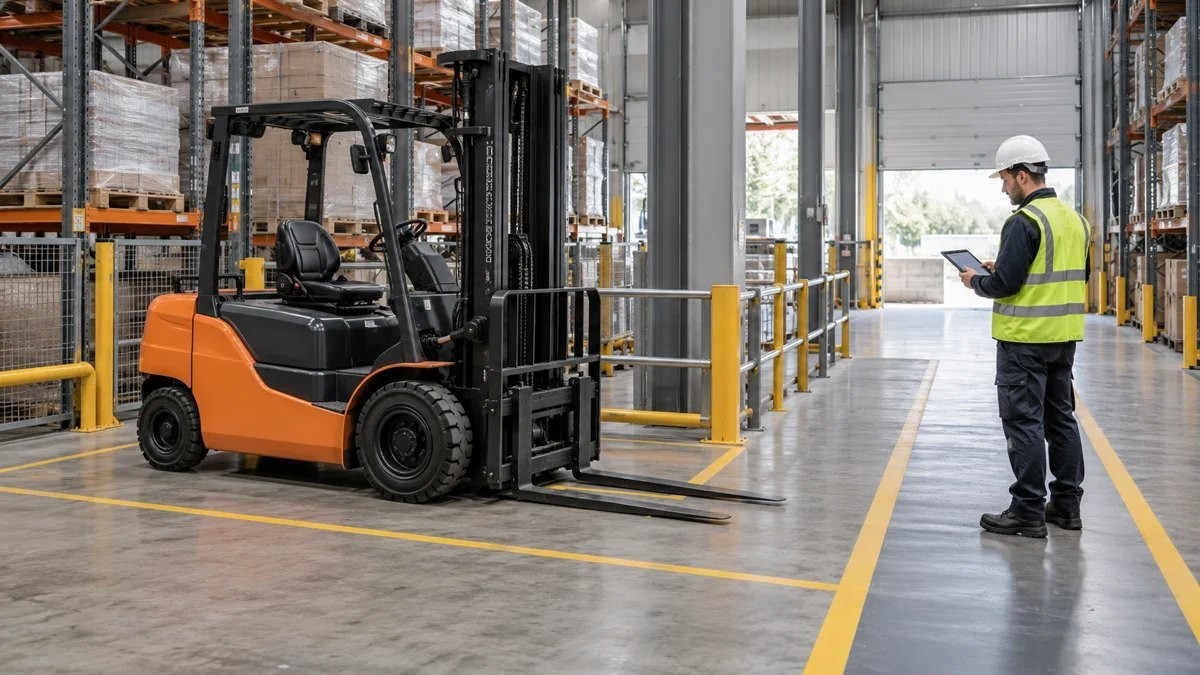
Start with a map of the site. Mark crossings, reversing areas, loading bays, blind corners and locations where a load blocks the operator's view. Separate routine traffic from unusual but foreseeable movements, such as a contractor entering a loading area.
For each location, write one requirement: which person or object needs to be detected, from which direction, and what action the operator should take.
An object warning and a pedestrian warning are different requirements. Likewise, detecting a wearable tag does not establish that the system can detect an untagged visitor. Make these distinctions explicit in the purchase specification.
Pedestrian separation, traffic routes and operator training remain part of the site plan. Warning technology adds information to that plan. HSE's workplace transport guidance treats vehicle safety, site layout and people as connected responsibilities.
Match the pilot to the detection method
Different systems need different test cases. Use the supplier's documented capabilities to build the test plan.
| System approach | What to verify in the pilot | Operational question |
|---|---|---|
| Tag-based proximity warning | Tag presence, battery condition, wear position and alarm behavior | How will workers, visitors and contractors receive and maintain tags? |
| Camera-based pedestrian detection | Field of view, partial obstruction, lighting and target appearance | What happens when the camera cannot see the person clearly? |
| Radar-based warning | Target response, installation angle and interaction with surrounding structures | Does the selected model distinguish people, or warn about nearby objects? |
| Combined system | Coverage and warning behavior of each layer | Can operators tell which warning requires which response? |
For a broader technology comparison, see Camera vs Radar vs UWB. Keep the pilot focused on the selected configuration rather than treating all products in a category as equivalent.
Build a controlled scenario matrix
Begin with a stationary forklift and the supplier's approved test method. Any later movement test should use a controlled area, trained personnel and a site-approved procedure. Do not place someone in the path of a moving truck to demonstrate detection.
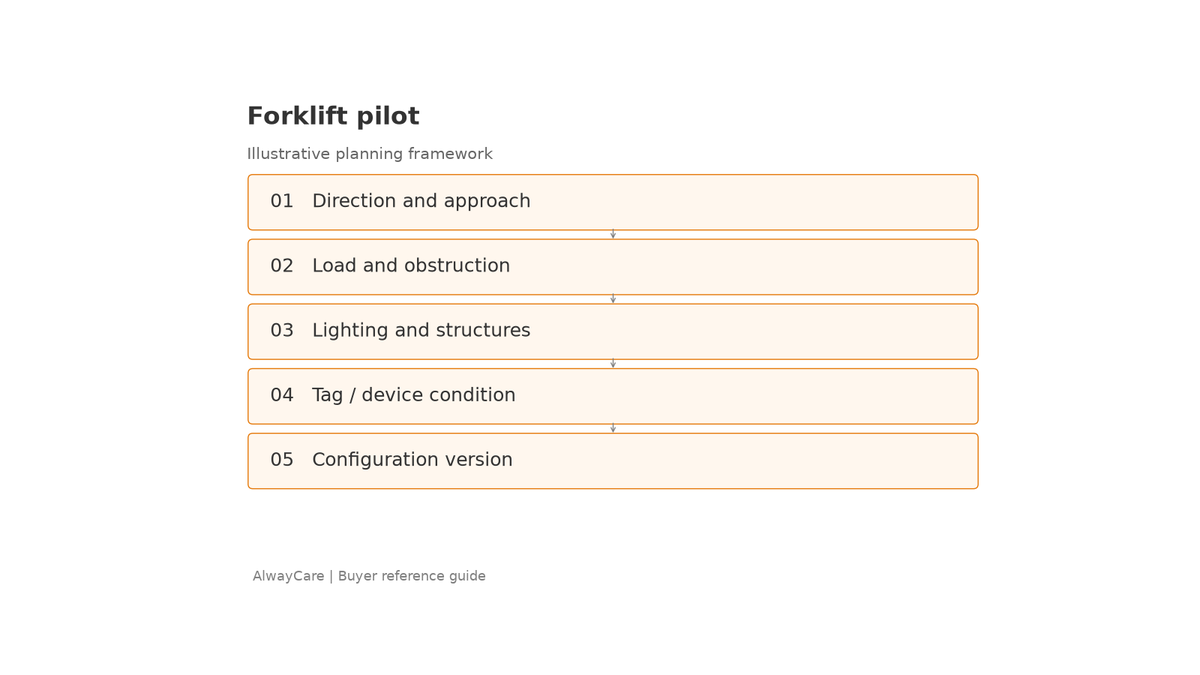
Include the operating variations that matter to the site:
- Front, rear and side approaches within the intended coverage.
- An empty truck and representative loads that may obstruct sensors.
- Indoor aisles, doorways and outdoor transitions used by the fleet.
- Nearby racks, parked vehicles and other structures.
- Relevant clothing, tag positions or approved test targets.
- Daylight, low light and the actual artificial lighting in use.
- More than one target or equipped truck, where supported by the system.
Record the hardware, firmware, mounting position and configuration before each test series. If a setting changes midway through the pilot, keep the earlier results under the earlier version. Otherwise, it becomes difficult to identify which configuration produced the outcome.
Measure warnings and misses separately
A useful test record captures more than whether an alarm sounded.
| Record field | Why it matters |
|---|---|
| Scenario and direction | Identifies coverage differences |
| Intended warning boundary | Defines the agreed test condition |
| Observed warning point | Shows how the actual warning compares with the plan |
| Missed or delayed warning | Reveals cases requiring investigation |
| Warning without the intended target | Helps identify nuisance alerts |
| Operator recognition | Confirms whether the warning was noticed and understood |
| Corrective action and retest | Keeps unresolved findings visible |
Set acceptance criteria before reviewing the results. A warning-zone distance should come from the site risk assessment and the system's limits. There is no single distance that suits every forklift, aisle and load.
Report misses by scenario as well as in the overall summary. Several successful open-area tests should not hide a failure at an important doorway.
Check the workflow that keeps the system available
For a tag-based system, test the process around the tags: issue, return, charging, replacement and checks before use. Include visitor management. A technically successful warning test still leaves a gap if a contractor does not receive a working tag.
For camera or radar systems, define who checks mounting, contamination, damage and system status. Confirm how the operator reports a fault and what the site does while coverage is unavailable.
Where a speed-control interface is proposed, treat it as a separate integration requirement. Obtain the forklift manufacturer's approval where required and verify the documented interface, failure behavior and commissioning procedure. An audible warning demonstration does not validate a vehicle-control function.
Adapt the test to each deployment location
For projects across Europe, North America, South Africa and South America, record the site conditions rather than assuming one regional configuration will suit every customer.
Confirm operator-language requirements, electrical compatibility, service responsibility and locally required documentation. If a fleet works between indoor warehouses and outdoor yards, include both environments. If contractors enter the site regularly, include their access process.
Distributor projects also need an installation handover: approved mounting drawings, configuration records, replacement-part identification and a repeatable local test procedure. This makes later vehicles easier to compare with the original pilot.
Make the purchase decision from an exception report
Close the pilot with three lists: accepted scenarios, scenarios requiring changes, and situations outside the system's declared capability. Assign an owner to each open item.
AlwayCare's UWB proximity warning systems and radar warning systems provide starting points for a configuration review. Ask for evidence for the exact model, mounting arrangement and interface proposed for the project.
For a project discussion, share the site layout and fleet details with AlwayCare, including forklift types, pedestrian access, target coverage and the proposed pilot scenarios.
Frequently asked questions
Can one pilot cover every forklift in a mixed fleet?
Only if the pilot represents the meaningful differences in vehicle geometry, loads, sensor positions and operating areas. Add test cases where those differences change coverage or warning behavior.
Is a tag-based system suitable for every visitor?
That depends on the site's ability to issue, check and recover tags. Include visitors and contractors in the operating plan rather than assuming that all people will carry a tag.
Does pedestrian detection prove collision prevention?
No. A pilot verifies detection and warning behavior within defined conditions. Collision risk also depends on traffic management, visibility, speed, operator response and other controls.