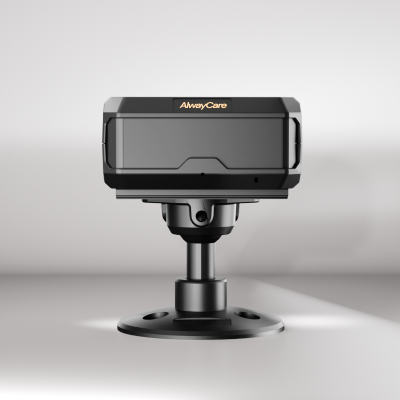
Driver Monitoring System Cost in 2026: What Fleets Actually Pay
Sep 28,2026
Budgeting Guide · Prices verified 28 September 2026
Driver Monitoring System Cost in 2026: What Fleets Actually Pay
Published price ranges from vendors who actually print them, the hidden costs that turn up after you sign, and a five-year total cost of ownership model comparing subscription against buying hardware outright. Every figure on this page is traceable to a named source.
4 cost tiers5-year TCO modelSources linked and dated10 min read
Short answer
Connected fleet camera hardware runs roughly $160–$1,200 per vehicle depending on channel count and on-device AI. Platform subscriptions run $15–$100 per vehicle per month. Professional installation adds $100–$300 per vehicle. Realistically, budget $480–$780 per truck per year all-in for a managed programme. Buy the hardware outright instead of subscribing and your cash cost falls — but you take on the platform, connectivity and support work yourself, and that effort is the number most fleets underestimate.
Global Compliance & Regulations Interactive Hub
Wondering if your commercial fleet is legally mandated to install DMS before budgeting hardware? Explore mandatory deadlines, UNECE ADDW/DDAW timelines, and country-by-country rules on our dedicated Global DMS Regulatory Compliance Hub.
Most pricing confusion comes from comparing products from different tiers. A $40 dashcam and a $1,200 AI system are not competing products — they solve different problems for different buyers. Here is what each tier actually costs, with the published figures.
Tier 1 — Aftermarket single-vehicle units
$40 – $620 per vehicle
Retail devices you buy and fit yourself. No fleet platform, no subscription required.
This is the range that dominates Google results for "driver monitoring system price", because it is the only tier with public retail pricing. GPS Insight segments it as entry-level at $40–$100, mid-tier at $70–$250, and multi-view at $300–$600. At the top of this tier, a BlackVue 3-channel DMS truck package lists publicly at $526.99–$619.99.
What you get: a genuine DMS channel, event recording, often cloud upload. What you do not get: fleet-level reporting, compliance evidence, driver scoring across a fleet, or centralised management. Fine for one to five vehicles. Not a fleet system.
Tier 2 — Connected fleet camera hardware
$160 – $1,200+ per vehicle
Purpose-built fleet hardware with cellular upload, GPS and increasingly on-device AI. Plus a subscription.
This is where fleets actually buy. Published ranges:
Nexar Fleets: hardware $159.95–$359.95 per camera, varying by road-facing versus dual-facing and by storage. Published on their fleet pricing page, verified 28 Sep 2026.
SureCam: road-facing connected dashcam $200–$400 per unit; dual-facing forward plus in-cab $250–$450; full multi-view on trucks and vans $500–$1,000 hardware alone. SureCam fleet dash cam cost guide, verified 28 Sep 2026.
GPS Insight: advanced AI dashcams $600–$1,200+, and their headline range across the category is "$40 entry-level models to $1200+ AI-enabled systems". GPS Insight cost analysis, verified 28 Sep 2026.
A dual-facing unit — one camera on the road, one on the driver — is the practical minimum for a DMS programme, which puts most fleet DMS hardware in the $250–$450 band before installation.
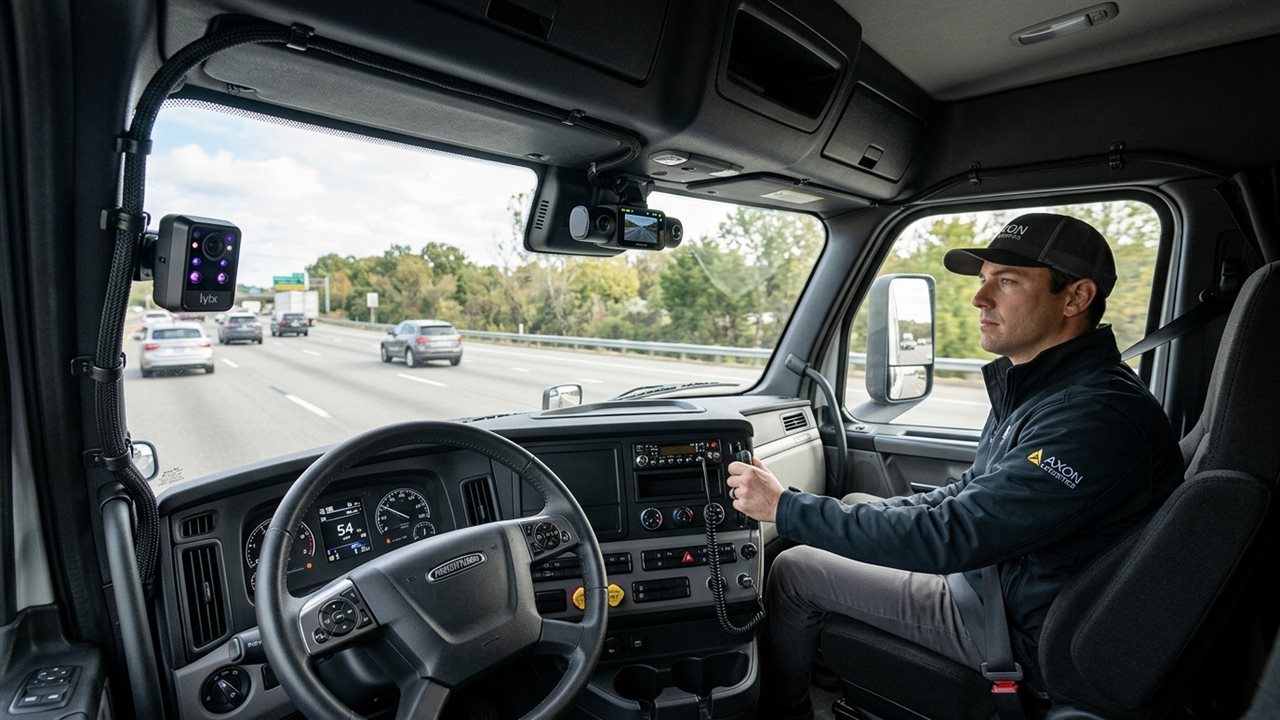
Figure 1: Commercial heavy-duty truck cabin deployment: A-pillar infrared DMS camera with active IR optical sensors, windshield-mounted dual-facing ADAS dashcam, and hardwired concealed wiring harness.
Tier 3 — Platform subscription
$15 – $100 per vehicle / month
The recurring line item, and over five years usually the largest one.
Nexar Fleets:$14.99–$24.99 per vehicle per month, including LTE, unlimited storage and unlimited live streaming. Published pricing page, verified 28 Sep 2026.
SureCam:$25–$100 per vehicle per month, depending on provider, feature tier and contract length. SureCam cost guide, verified 28 Sep 2026.
Note what sits inside that spread: $15 and $100 per vehicle per month are the same category of product at different feature tiers and contract lengths. When you compare quotes, check whether LTE data, cloud storage, live streaming, driver scoring and coaching workflow are included or billed separately. That single question explains most of the difference.
Tier 4 — OEM/ODM hardware, no subscription
Project-quoted per unit
For distributors, integrators, vehicle manufacturers and operators who already run a platform.
This tier is not priced like the others and you will not find it on a public price list, because per-unit cost depends almost entirely on your configuration and volume. The drivers are:
Detection capability — infrared pupil/eye tracking with multi-stage alerts costs more than head-pose estimation
Channel count — standalone DMS versus DMS plus ADAS plus blind spot plus 4–13 channel recording
Where AI runs — on-device processing versus streamed to a platform
Connectivity — 4G versus Wi-Fi only versus none
Storage — single card versus dual tamper-proof cards up to 1 TB
Certification — a CE/UKCA/RED/RoHS/WEEE pack and automotive-grade manufacturing add cost, and it is the part buyers most often try to skip
Volume and MOQ — the single biggest lever
Customisation — your branding, your firmware, your protocols
A caution about marketplace price lists
You will find per-unit DMS figures on B2B marketplaces ranging across an order of magnitude. Treat them with care: they typically reflect a bare board or camera module at a large minimum order quantity, with no certification pack, no firmware support and no warranty terms comparable to a fleet-grade unit. They are not comparable to a quoted system price, and we deliberately do not reproduce them here because doing so would mislead your budgeting.
If you are procuring at this tier, ask for a quote structured against your actual configuration. Anything else is guesswork.
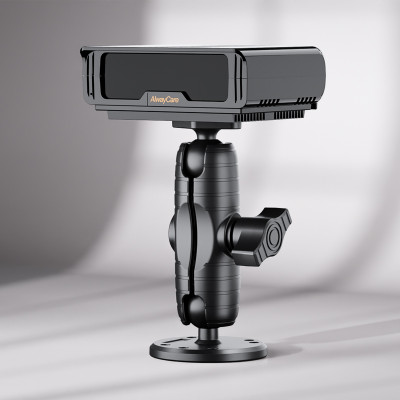
For fleets, integrators and manufacturers procuring at this tier, AlwayCare provides automotive-grade, factory-direct hardware with zero recurring monthly subscription fees:
for all-in-one DMS with forward ADAS and BSD, explore the MR830 All-in-One DMS;
for standalone in-cab fatigue alerting, see the MR810;
for dual-card recording up to 1 TB, see the MR910-D AI MDVR;
and for in-cab sensor camera integration into third-party telematics gateways, explore the CC1011 In-Cab DMS Camera.
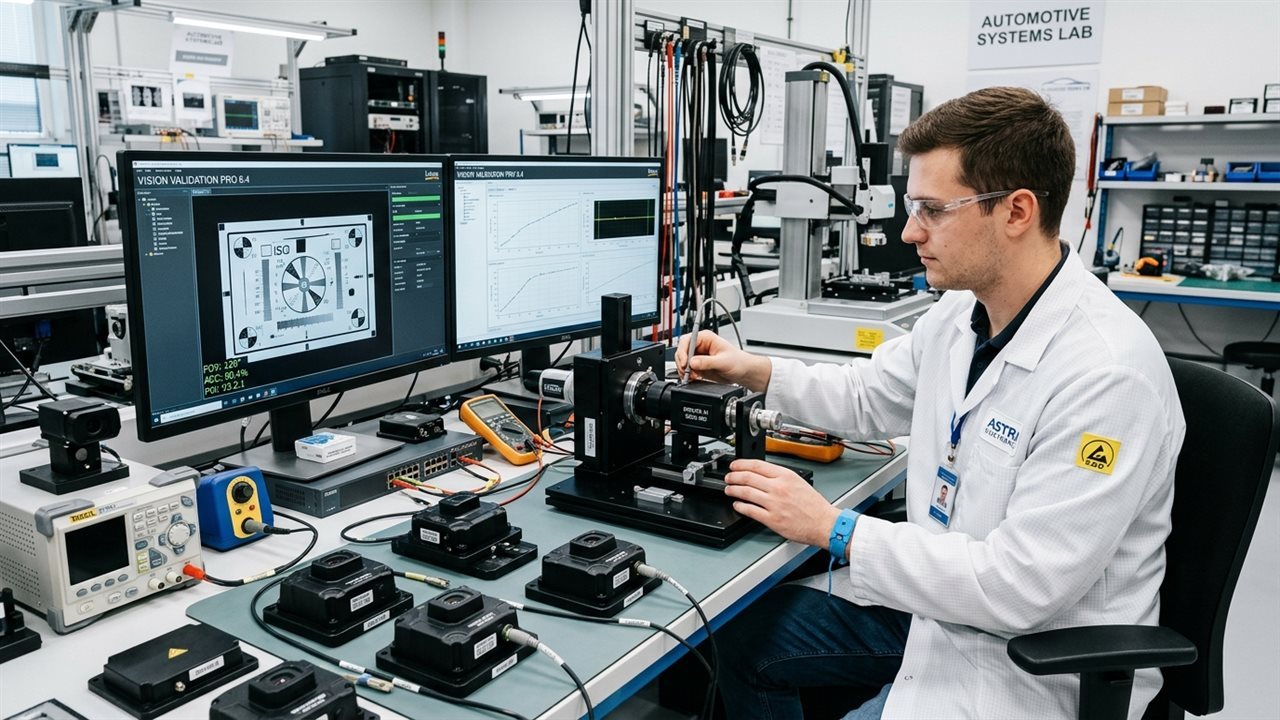
Figure 2: Automotive electronics engineering and quality testing laboratory: precision optical sensor calibration, firmware validation, and environmental testing of rugged commercial DMS hardware compliant with IATF 16949.
Why this tier matters commercially: there is no per-vehicle recurring fee for the device. You buy hardware, you own it, and you integrate it with the platform you already run. That changes the five-year arithmetic substantially — see the TCO model below. It also changes who carries the operational burden, which is the trade-off most fleets underestimate.
What actually drives the price
Twelve variables separate a $200 unit from a $1,200 unit. Ranked roughly by how much they move the number:
Driver
Cheaper end
Expensive end
Channel count
1 road-facing
Multi-view: forward, in-cab, sides, rear
Detection method
Head-pose estimation
Infrared eye + head tracking with multi-stage alerts
Certification is not a cost to negotiate away. It is usually the difference between a unit you can insure, register and defend in a claim, and one you cannot. When a quote comes in far below the others, certification and warranty cover are the two things to check first.
The hidden costs nobody quotes
These are the line items that turn a hardware quote into a programme budget. SureCam's cost guide is unusually candid about several of them, and it is worth reading in full before you model anything.
Cost
Typical amount
Notes
Professional installation
$100–$300 per vehicle
SureCam's published figure, in most markets. On a 50-truck fleet that is $5,000–$15,000 at launch. Self-install avoids it but costs driver and technician time instead.
Cellular data / SIM
Inside the subscription, or separate
Sometimes bundled into the per-vehicle fee, sometimes billed as data. Confirm which. This is a common source of month-2 invoice surprises.
Cloud storage overage
Varies — often per GB
Unlimited storage is advertised by some vendors and metered by others. If video retention is a compliance requirement, model your actual volume.
Integration with your existing systems
Internal or contract dev time
Getting events into your TMS, FMS or safety workflow. Frequently the largest unbudgeted item on the hardware route.
Platform ownership (hardware route only)
Internal — highly variable
Hosting, dashboards, alerting, user management, upgrades, security patching. This is the real cost of not paying a subscription.
Driver communication and consent
Staff time, plus possible works-council delay
Not a line item anyone quotes, and the most common cause of a rollout stalling. Budget the time explicitly.
Hardware refresh mid-contract
~30% of original hardware cost at year 4
Cameras fail, get damaged, or become unsupported. Where the platform is bundled, refresh is usually included — one of the genuine advantages of the subscription model.
Early termination
Remaining contract value
Read this clause. A 60-month term is a 60-month commitment; that is precisely what makes the monthly figure look low.
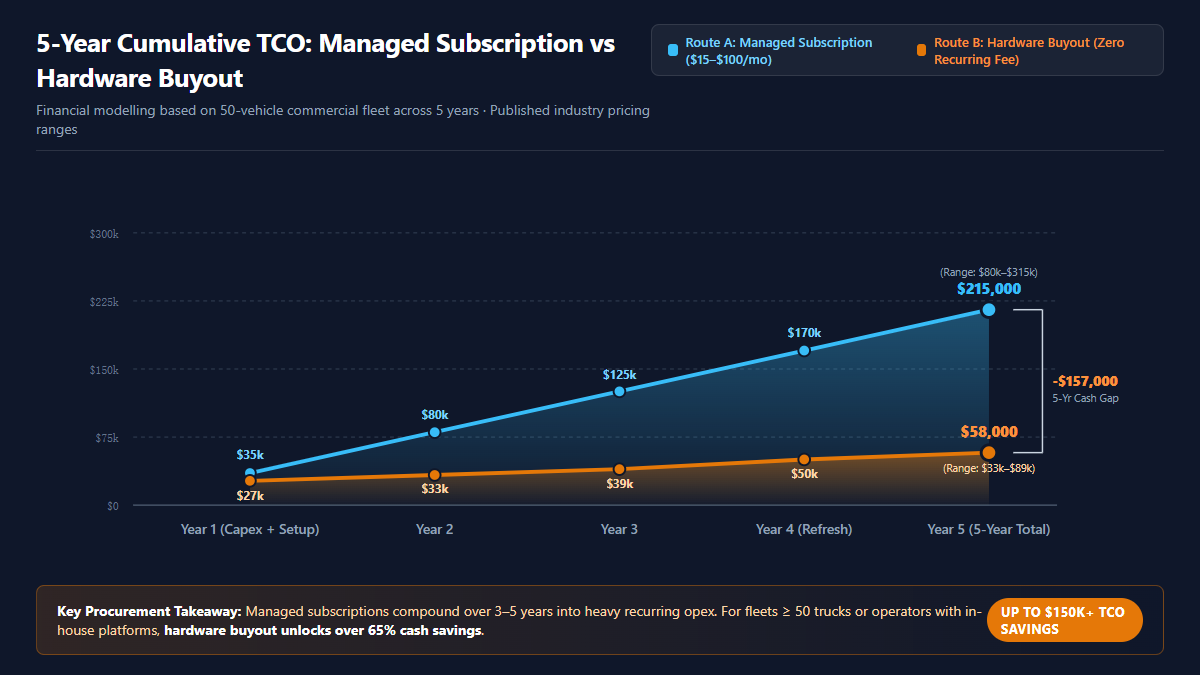
Figure 3: 5-year cumulative Total Cost of Ownership (TCO) comparison for a 50-vehicle commercial fleet: Managed Subscription (Route A) compounding into heavy recurring opex vs Hardware Buyout (Route B) delivering up to $157,000 in cash savings.
5-year TCO: subscription vs buying hardware
This is the comparison that decides most DMS procurements, and the one almost nobody publishes. Here it is modelled on a 50-vehicle fleet over 5 years, using published price ranges. Figures are illustrative modelling at the stated assumptions — not quotes, and not our prices.
Assumptions
50 vehicles. 5-year horizon. Managed route priced at $25–$100 per vehicle per month depending on tier and contract length. Hardware route uses dual-facing fleet units at $200–$450 per vehicle. Installation at $100–$300 per vehicle either way. Connectivity on the hardware route at $5–$15 per vehicle per month. Excludes inflation, discounting and internal staff costs (which are shown separately because they dominate the hardware route).
Cost line
Route A — Managed subscription
Route B — Buy hardware, own the platform
Hardware
Bundled or discounted into the subscription
$10,000 – $22,500 one-time
Installation
$5,000 – $15,000 one-time
$5,000 – $15,000 one-time
Subscription / device fee
$75,000 – $300,000 over 5 years
$0 no per-device fee
Connectivity / SIM
Usually included — confirm
$15,000 – $45,000 over 5 years
Platform, hosting, engineering
Included
Internal — the swing factor
Hardware refresh (year 4)
Usually included
~$3,000 – $6,750
Cash cost over 5 years
$80,000 – $315,000
$33,000 – $89,000plus internal platform effort
How to read that table honestly
Route B looks dramatically cheaper in cash, and on a large fleet it usually is. But three qualifications matter more than the headline:
You are buying an obligation, not just saving money. Route B only works if you have — or will build — the capability to run a safety platform: hosting, dashboards, alert routing, user management, upgrades, security patching. If you do not have that, you have not removed the cost, you have moved it into headcount you have not hired.
The subscription is buying more than hardware access. Vendor platforms bundle driver scoring, coaching workflow, reporting, compliance evidence and hardware refresh. Building equivalents is a product project, not an IT ticket.
At small fleet sizes the maths flips. Running your own platform has fixed costs that do not scale down. For 10–20 vehicles the subscription is usually the better decision regardless of the per-vehicle rate, because the fixed effort dwarfs the saving.
Where the hardware route genuinely wins
Three situations, and they are common:
You already run a telematics or video platform. The integration work is done. Adding detection hardware is incremental, and the subscription saving is close to pure margin.
You are a distributor, integrator or vehicle manufacturer. You need to own the hardware layer, brand it and control firmware — which no platform subscription will give you.
You are deploying at scale. At 500-plus vehicles a per-vehicle monthly fee compounds into six figures annually. Buying hardware outright and running the platform is where large fleets find real money.
Budget by fleet size
Year-one cash outlay at indicative mid-range assumptions, using published figures. Illustrative — get real quotes before committing a budget.
Fleet size
Route A — Year 1 subscription
Route B — Year 1 hardware + install
Practical note
10 vehicles
$3,000 – $12,000
$3,000 – $7,500
Subscription usually wins once you cost your own platform effort. Consider aftermarket units at this size.
50 vehicles
$15,000 – $60,000
$15,000 – $37,500
The crossover zone. Decide on capability, not price — can you run a platform?
200 vehicles
$60,000 – $240,000
$60,000 – $150,000
Hardware route becomes clearly cheaper if you have platform capability. Model refresh at year 4.
1,000 vehicles
$300,000 – $1,200,000
$300,000 – $750,000
Large enough to fund your own platform from the saving. ODM pricing and phased rollout both become available.
One structural note: at 1,000 vehicles the spread between the low and high subscription figure is $900,000 a year. That gap is not driven by hardware at all — it is feature tier and contract length. Which is why the negotiation section below matters more than the hardware comparison at scale.
The ROI numbers to put in your business case
No DMS purchase gets approved on cost alone. Here are the published figures you can use, all attributable.
Return line
Published range
Source
All-in programme cost
$480 – $780 per truck per year
Hardware, subscription, installation and coaching overhead combined
Insurance premium reduction
5% – 20%
Reported for fleets that package monitoring evidence; 15–25% cited by some sources for advanced video telematics. A basic camera programme alone may attract 5–10%.
Premium saving per truck
$300 – $1,200 per year
Published return stack, per truck per year
Collisions avoided
$400 – $2,500 per truck per year
Published return stack
Exoneration value
$200 – $1,500 per truck per year
Published return stack — claims successfully defended with video evidence
Manager time saved
$200 – $400 per truck per year
Published return stack
Claims cost reduction
30% modelled
A fleet spending $80,000 a year on claims saves $24,000 annually; a system costing $15,000 a year pays back in under 8 months on claims alone
Average at-fault claim payout
$15,000
Published reference figure used in fleet ROI modelling
Accident reduction
52% in 12 months
Reported for a 310-vehicle deployment with dual cameras and real-time coaching, alongside an 80% reduction in distraction events
Behaviour improvement
65% – 80% within 30–60 days
Reported under real-time coaching; distraction events down around 60% by 90 days
Do not forget the driver-acceptance numbers
These are cost-relevant because a system drivers resist is a system that gets unplugged — and that makes the entire investment worthless. From a survey of more than 3,500 professional drivers: 92% expressed concern about in-cab cameras, citing footage used out of context, use for disciplinary action, data security and being monitored. But 92% would accept cameras that could exonerate them, and approval rises by 87% when footage is used for proactive coaching rather than discipline.
Fleets that frame cameras as driver protection, publish a written privacy policy and share real exoneration stories report over 80% acceptance within 60 days. That gap is entirely communication and policy — and it costs nothing except doing it before installation rather than after.
What is actually negotiable
Hardware list prices are less fixed than they look, and the recurring line is where the real money is. In rough order of leverage:
Contract length against monthly rate. The single biggest lever. A 36-month commitment typically prices below a monthly rolling term — but only if you are confident in the vendor for the full term.
Volume tiers. Staircase pricing is standard. Ask for the tier boundaries explicitly rather than accepting a single blended rate.
Hardware bundled into subscription. Some vendors will fold hardware and installation into the per-vehicle fee, converting capex to opex. Ask — it is often available and not offered by default.
Paid pilot. A 10–25 vehicle, 90-day paid pilot with defined success criteria usually gets better terms than a one-shot negotiation, and gives you false-positive data before committing fleet-wide.
Installation. Often quoted at a standard rate and negotiable at volume, or removable if you install in-house.
Refresh inclusion. Get hardware replacement during term written in. This is a genuine subscription advantage — do not give it away.
Data egress and termination. Ask what it costs to export your data, and what happens to it if you leave. Get it in the contract.
Red flags in DMS pricing
A price far below every other quote. Check certification and warranty first. Uncertified hardware is not insurable or defensible in the way you need.
"Unlimited" without a definition. Unlimited storage, unlimited streaming, unlimited data — ask what the fair-use limit is and what triggers overage.
Per-camera charges when you expected per-vehicle. A 4-camera vehicle billed per camera is four times the assumed cost. Clarify the unit of billing before you compare anything.
Hardware you do not own at the end of term. Some subscriptions assume return or continued payment. If you plan to sweat the asset, confirm ownership.
Feature-gated basics. Driver scoring, coaching workflow, API access and data export held in an upgrade tier will cost you more than the headline rate suggests.
Long term, no exit. A 60-month term with full remaining-value termination and no data portability is a trap, not a discount.
Installation quoted separately and vaguely. "From $X" installation quotes have a way of becoming $X plus harnesses, plus calibration, plus a return visit.
No pilot offered. If a vendor will not let you measure false positives on your own routes before a fleet-wide commitment, you are buying an unquantified alert load.
Frequently asked questions
How much does a driver monitoring system cost per vehicle?
For fleet-grade hardware, budget $160–$1,200 per vehicle depending on channel count and whether AI runs on-device, with most dual-facing DMS units landing in the $250–$450 band. Add $100–$300 per vehicle for professional installation. If you take a managed platform, add $15–$100 per vehicle per month. As a planning figure, published sources put an all-in managed programme at $480–$780 per truck per year including hardware, subscription, installation and coaching overhead.
Is it cheaper to buy DMS hardware or pay a subscription?
In cash terms, buying hardware is almost always cheaper over five years — on a 50-vehicle fleet the modelled difference is roughly $80,000–$315,000 versus $33,000–$89,000. But that comparison is not complete, because the hardware route requires you to run the platform: hosting, dashboards, alerting, integration, upgrades and security. If you already operate a telematics platform, that work is largely done and buying hardware is clearly better value. If you do not, you are not saving money, you are converting a subscription into headcount. At 10–20 vehicles the subscription usually wins regardless, because fixed platform costs do not scale down.
What does a fleet dash cam cost per vehicle per month?
Published vendor pricing puts fleet software subscriptions at $14.99–$24.99 per vehicle per month at the lower tier and $25–$100 per vehicle per month across the wider market, depending on provider, feature set and contract length. The spread is mostly about what is bundled: LTE data, cloud storage, live streaming, driver scoring and coaching workflow may be included or billed separately. Always confirm which before comparing two quotes.
Are there hidden costs I should budget for?
Yes, and they are the reason programmes overrun. The most commonly missed are professional installation at $100–$300 per vehicle, cellular data if it is not bundled, cloud storage overage, integration work to get events into your existing systems, and the platform ownership cost on the hardware route. On top of those, budget staff time for driver communication and any works-council or consent process — it is not a line item anyone quotes, but it is the most common cause of a rollout stalling.
Will a driver monitoring system reduce my insurance premium?
Usually, but not automatically. Published figures put premium reductions at 5%–20% for fleets that package monitoring evidence properly, with 15%–25% cited by some sources for advanced video telematics. A basic camera programme alone may attract 5%–10% simply by existing. Two conditions matter: the programme has to be actively managed, with documented coaching rather than just cameras installed, and some carriers now require camera programmes for coverage at all. Ask your broker what evidence they need before you choose a vendor — that answer should shape your specification.
How much does it cost to install a DMS per vehicle?
Professional installation runs $100–$300 per vehicle in most markets. On a 50-truck fleet that is $5,000–$15,000 at launch. Self-installation removes the cash cost but consumes driver and technician time, and on hardwired multi-camera systems with calibration requirements it is usually not realistic to do in-house. Plug-and-play OBD units are the exception and can reasonably be self-installed.
Why do DMS quotes vary so much between vendors?
Four reasons, in order of impact. First, the unit of billing — per vehicle versus per camera makes up to a four-fold difference on multi-camera vehicles. Second, what the subscription includes versus bills separately, particularly data and storage. Third, the detection method — infrared eye and head tracking with multi-stage alerts costs materially more than head-pose estimation, and the two are often quoted as if equivalent. Fourth, certification and warranty cover, which cheap quotes frequently omit and which determine whether the hardware is insurable and defensible in a claim.
Sources
Every figure on this page was taken from the following published sources on 28 September 2026. We used ranges as published rather than converting or estimating. Where a figure could not be confirmed against a named published source, it was omitted rather than estimated.
Nexar Fleets — published fleet pricing: hardware $159.95–$359.95, software $14.99–$24.99 per vehicle per month — fleet.getnexar.com
FleetRabbit — AI dash cam integration: programme cost per truck per year, insurance reduction ranges, return stack, driver acceptance survey data, accident and distraction reduction figures — fleetrabbit.com
BlackVue — public retail listing for a 3-channel DMS truck package — shop.blackvue.com
How to use these numbers
These are market ranges from published sources, not quotes, and pricing moves. Treat the tables as a budgeting framework and the assumptions as the thing to challenge. When you request quotes, ask each vendor to price the same vehicle count, the same channel configuration and the same contract length — otherwise you are comparing four different products.