

dms vs. adas vs. ai dashcam: what is the difference?
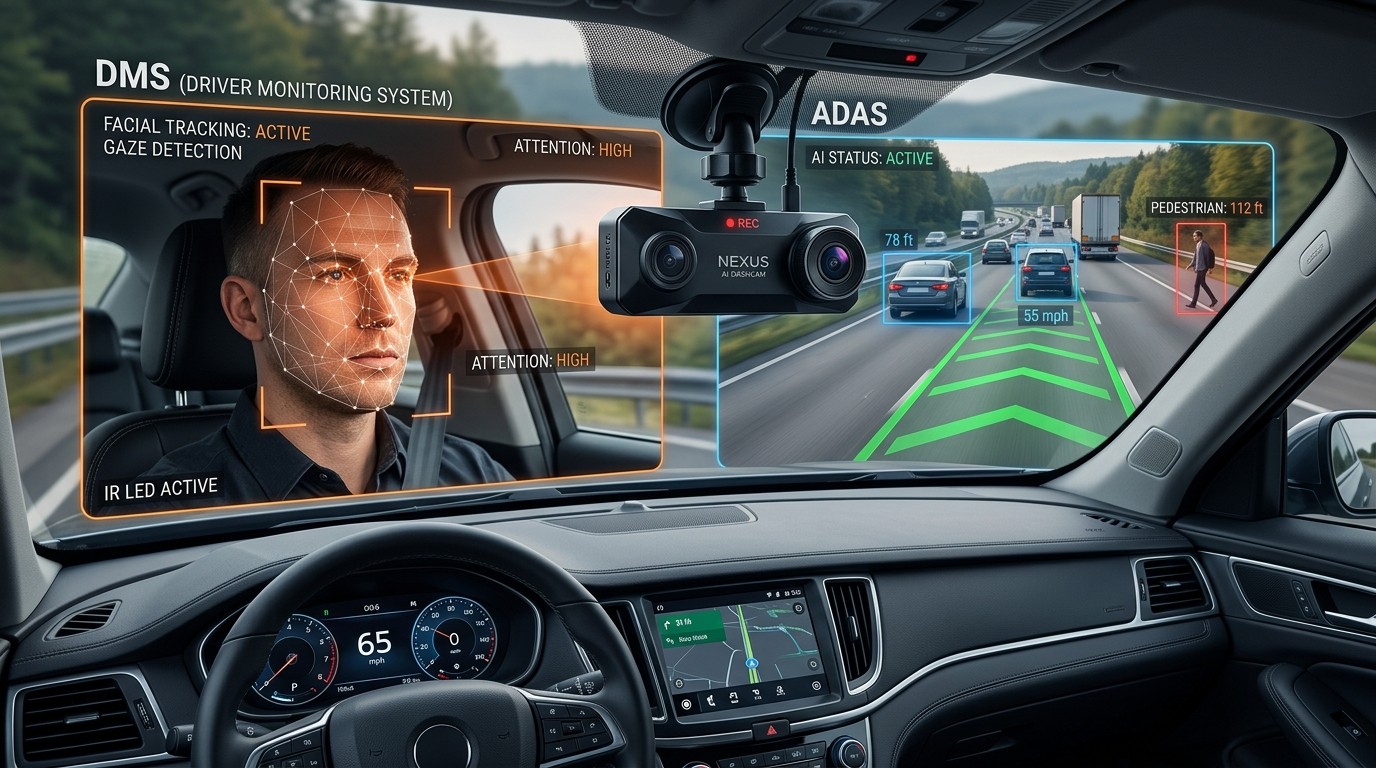
Visual Breakdown: In-cabin DMS optical tracking (Left), Windshield-mounted AI Dashcam platform (Center), and Roadway ADAS perception (Right).
A Driver Monitoring System (DMS) is a safety function that assesses driver alertness, attentiveness, and observable distraction cues using direct in-cabin sensing, indirect vehicle signals, or both. An Advanced Driver Assistance System (ADAS) monitors the vehicle’s external environment and may warn the driver or assist through braking or steering, depending on vehicle integration. An AI Dashcam is a video-telematics device and service platform that uses onboard processing to record and classify driving events. Depending on its sensors and configuration, it may host DMS functions, ADAS warning functions, or both. In short: DMS and ADAS are safety functions; an AI dashcam describes a physical device and platform that may deploy them.
Comparison Matrix: Key Differences
| Dimension | DMS (Driver Monitoring) | ADAS (Driver Assistance) | AI Dashcam (Telematics Platform) |
|---|---|---|---|
| Primary Focus | In-Cabin (Driver attention, observable cues) | Exterior Roadway (Traffic, lane boundaries) | Unified (Cab, Road, Vehicle dynamics) |
| Classification | Safety Function (Algorithm / Sensing) | Safety Suite (Algorithm / Control) | Edge Device & Telematics Platform |
| Typical Sensors | Near-IR camera, steering sensors, CAN data | Optical CMOS, Radar, LiDAR, Ultrasonic | Configurable: CMOS, IR LEDs, IMU, GNSS, LTE |
| Intervention Capability | Warning-only (Chimes, spoken alerts) | Warning-only (Aftermarket) OR Active (OEM Braking) | Warning-only in-cab audio coaching |
| Cloud Video Storage | Function-level only (unless via telematics) | Function-level only (unless via telematics) | Core Feature: Event-triggered HD upload |
| Regulatory Context | EU GSR (DDAW & ADDW mandates) | NHTSA FMVSS 127 (AEB), Euro NCAP | Insurance risk underwriting & litigation defense |
1. What Is a Driver Monitoring System (DMS)?
A Driver Monitoring System (DMS) evaluates driver alertness and observable distraction cues. Commercial fleets implement two distinct approaches:
- Direct Optical DMS: Utilizes in-cabin near-infrared cameras to track head-pose angle, eye-gaze direction, and blink rates. Explore our technical breakdown of direct optical DMS solutions for commercial fleets.
- Indirect DMS: Analyzes vehicle dynamic metrics—such as steering wheel angle variance or lane weaving—to infer fatigue without an in-cabin camera.
Optical Sensing & Low-Light Performance:
Near-infrared (NIR) illumination (850nm or 940nm) supports night monitoring and may improve eye visibility through some sunglasses; however, performance varies with lens tint, polarization, IR-blocking coatings, frame occlusion, and camera placement.
2. What Is an Advanced Driver Assistance System (ADAS)?
An Advanced Driver Assistance System (ADAS) monitors external roadway hazards. For deeper engineering insights, read our complete guide to commercial vehicle ADAS architectures.
⚠️ Warning-Only ADAS (Passive)
Emits low-latency audible and visual alerts (such as Forward Collision Warning or Lane Departure Warning). Aftermarket dashcam systems operate in this category because they do not actuate mechanical steering or braking controls.
🛑 Intervention-Capable ADAS (Active)
Directly actuates vehicle braking or steering to execute Automatic Emergency Braking (AEB) or Lane Keeping Assist (LKA). Requires deep factory CAN-bus integration and ISO 26262 ↗ functional safety compliance.
3. What Is an AI Dashcam?
A commercial AI Dashcam is the physical edge-computing telematics platform. Fleets looking for unified risk reduction often deploy enterprise dual-facing AI dashcams that host road and cabin algorithms on a unified onboard processor.
Edge vs. Cloud Architecture: In systems engineered for offline reliability, latency-critical detection and in-cab audio alerts run locally on the edge processor without cellular dependency. Cloud portals handle video triage, secondary false-positive filtering, driver coaching workflows, and long-term compliance storage.
Regulatory Realities: EU GSR vs. US Rulemakings
Understanding legal compliance prevents expensive procurement errors across international markets:
1. European Union General Safety Regulation
The European Commission established mandatory active safety requirements under official Regulation (EU) 2019/2144 ↗:
- DDAW (EU 2021/1341 ↗): Driver Drowsiness and Attention Warning applies to M and N vehicles traveling >70 km/h. It is a performance standard and does not mandate a camera.
- ADDW (EU 2023/2590 ↗): Advanced Driver Distraction Warning evaluates prolonged gaze away from forward roadway zones (Area 3 fixation targets) for all new registrations from July 2026.
- Euro NCAP: Independent from statutory law, Euro NCAP Safe Driving Protocols ↗ award consumer safety points to continuous direct eye- and head-tracking DMS.
2. United States: NHTSA & FMCSA Rulemakings
- Light Vehicles (NHTSA FMVSS 127 ↗): Mandates Automatic Emergency Braking (AEB) on passenger vehicles up to 10,000 lbs by September 2029.
- Heavy Trucks: NHTSA and FMCSA issued a joint Notice of Proposed Rulemaking (NPRM) ↗ proposing AEB on commercial vehicles >10,000 lbs GVWR.
Empirical Safety Data: Primary Research Findings
Commercial truck drivers performing text messaging were approximately 23 times as likely to experience a safety-critical event compared with non-distracted baseline driving.
Trucks equipped with AEB and FCW were associated with an approximately 40% lower crash rate (FCW alone associated with ~30%; LDW with ~21%). Evaluated on 2005–2021 model trucks.
ATRI documents the growth of large commercial verdicts. Time-stamped road video and telemetry assist safety teams in reconstructing disputed incidents.
500-Truck Fleet Governance: Privacy & Alert Workload
1. Driver Privacy & Policy Governance
Document whether the system continuously records locally, uploads only triggered clips, permits remote live-view or retrieval, and operates while parked. Audio recording should remain disabled unless supported by documented operational necessity and labor review.
2. Alert Workload Economics & ROI
Illustrative scenario: In a 500-vehicle fleet, 8 daily unverified alerts per vehicle produces 4,000 clips per day. At 45 seconds per manual review, triaging 4,000 clips equals 50 labor hours daily—exceeding six eight-hour reviewer shifts. Fleets require a combination of calibrated edge thresholds, context suppression, event deduplication, and secondary cloud filtering. Estimate your savings with our interactive fleet telematics ROI calculator.
3. Pilot Roadmap & Free Evaluation Matrix
Before full fleet deployment, run a 30-day shadow baseline followed by active in-cab coaching. Safety leaders can benchmark on-road test results using our downloadable 30-60-90 Day Fleet Pilot Evaluation Matrix (PDF).
Frequently Asked Questions
Q: Can an aftermarket AI dashcam replace factory OEM ADAS?
No. Aftermarket AI dashcams provide warning-only (passive) ADAS via audible alerts. Factory OEM ADAS provides intervention-capable (active) control such as Automatic Emergency Braking (AEB). An AI dashcam complements OEM systems by adding cloud video telematics and coaching metrics.
Q: Does a Driver Monitoring System legally require an optical camera?
Not in all contexts. Regulatory frameworks like EU GSR DDAW permit indirect monitoring via steering metrics, while direct optical near-infrared tracking is required for visual distraction (ADDW) and high Euro NCAP consumer safety ratings.
Q: How does an AI dashcam function in areas without cellular connectivity?
In systems designed for offline safety operation, latency-critical detection and in-cab audio alerts run locally on the edge processor without cellular dependency. Event clips queue in onboard storage and sync automatically once network connectivity resumes.
🔗 Related Fleet Telematics Resources
Explore our specialized active safety guides and tools to optimize your fleet safety architecture: