AHD vs IP Vehicle Cameras: Compatibility, Cabling and Use Cases
AHD and IP vehicle cameras use different signal paths. AHD cameras require compatible recorder inputs and cabling; IP cameras require a compatible network and power arrangement. Choose by the exact camera-recorder pairing, vehicle layout and recording workflow, rather than assuming one type always offers better resolution or AI functions.
What AHD and IP mean on a vehicle
AHD (Analog High Definition) is a transmission standard: the camera outputs video over a coaxial cable, and the recorder (typically an MDVR) converts and stores it. One cable per camera, point to point.
IP (Network) cameras encode video inside the camera and send it as data over Ethernet. On a vehicle this usually means a network switch between cameras and the recorder, and bandwidth management instead of one-cable-per-camera.
Both record. The difference is the path, the processing, and what the recorder must support.
Side-by-side comparison
| Factor | AHD camera | IP camera |
|---|---|---|
| Cable | Coaxial, point to point | Ethernet, via switch |
| Video delay | Very low — near real-time | Low, but adds encode/network steps |
| Resolution | HD typical on vehicle systems | Scales higher where needed |
| Cabling effort | Simple per camera | Needs switch placement and bandwidth planning |
| Recorder side | MDVR with AHD inputs | Recorder/NVR with IP channels |
| AI processing | Usually in AI cameras or the MDVR | Can run in-camera or server side |
| Cost structure | Lower per camera, predictable | Higher system complexity |
A common conclusion: AHD for straightforward multi-camera recording; IP where on-camera intelligence or high resolution justifies the added system design.
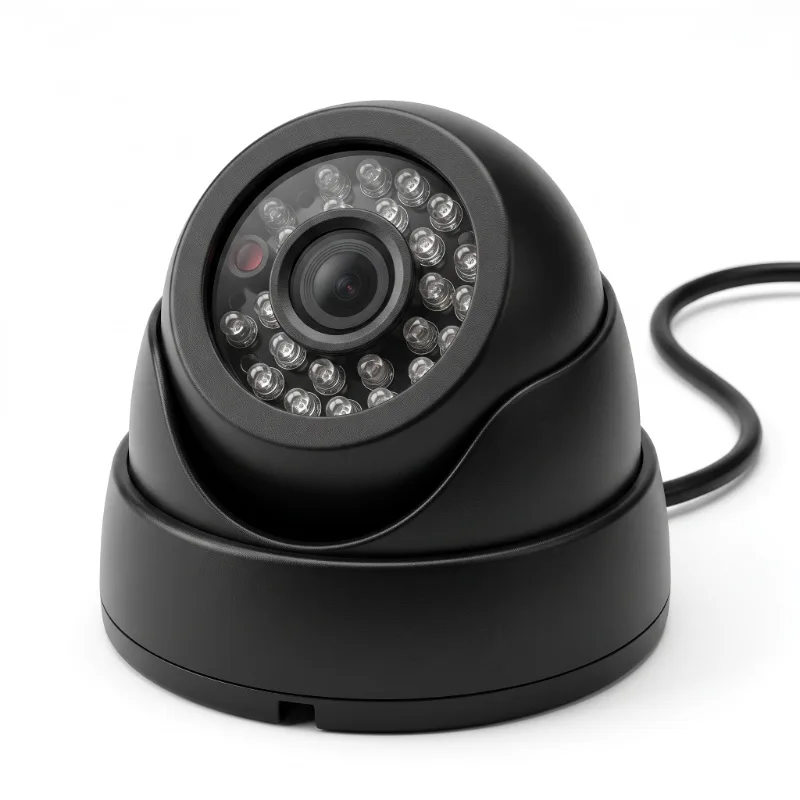
Vehicle dome camera: the connector type must match the recorder input.
Why latency matters more on vehicles
A reversing or lane-change camera is used while the vehicle moves. Every extra processing step adds delay between what happens and what the driver sees. AHD's direct analog path keeps delay minimal — one reason it remains the default on commercial vehicle recording systems. IP video can also work well, but the encode-transmit-decode chain must be designed for it.
Compatibility: the part that actually breaks projects
Most "the camera does not work with my recorder" problems are protocol mismatches, not faults:
- An IP camera will not show a picture on an AHD input, and the reverse.
- Mixed systems need a recorder that offers both input types — some AI MDVRs combine AHD recording channels with IP channels reserved for AI cameras; the split varies by model, so check the specification sheet.
- Cable quality and connector sealing matter for both — a vehicle environment adds vibration, moisture, and temperature stress that office-grade parts are not built for.
A 5-point compatibility checklist before ordering
- List each camera position and what it does: recording only, or AI detection too.
- Match camera protocol to recorder inputs — channel by channel.
- Confirm cable runs: coaxial length per AHD camera; switch position and bandwidth for IP.
- Confirm monitor inputs if cameras also display live.
- Put the input-type and channel split in the quotation — not just "8-channel".
Honest limit: camera protocol decides whether a system works together; it does not make a vehicle safer by itself. Detection quality still depends on camera placement, calibration, and the limits of the AI functions themselves.
Frequently asked questions
Can AHD and IP cameras work on the same MDVR? Only if the recorder provides both input types. Some AI MDVRs pair AHD recording channels with IP channels for AI cameras — the split is model-specific and must be confirmed on the specification sheet.
Which has less delay, AHD or IP? AHD's direct analog path is near real-time. IP adds encoding and network steps, so delay depends on the implementation. For fast-moving reversing tasks, AHD is the safer default.
Is IP better for camera resolution? IP scales to higher resolutions more easily because video is compressed in-camera. AHD covers the HD range common on vehicle systems. Choose by need, not by maximum spec.
Why does my camera show no picture on my recorder? The most common cause is a protocol mismatch — an IP camera on an AHD input or vice versa. Check the camera standard, the recorder input type, the cable, and connector seating in that order.
Do IP cameras need a switch on a vehicle? Usually yes, when more than one IP camera connects to one recorder. The switch adds a component to mount, power, and protect — factor it into the installation plan.
Match the protocol to your recorder before you buy
Send us your camera positions and your recorder model — we will check protocol compatibility, cable plan, and input allocation before you order.
- Browse our Vehicle Camera range and Mobile DVR systems, or our AI Camera line for detection functions.
- Deciding transmission type first? Read Wired vs Wireless Backup Cameras.
- Planning channel counts? See 4-Channel vs 8-Channel vs 12-Channel MDVR.
- Wireless instead of coax? Read Wireless Vehicle Cameras: Selection and Installation Guide for Fleets
- Checking image quality at night? See Night Vision Truck Cameras: How to Test Image Quality
- Commercial Vehicle Camera Systems — the complete guide